
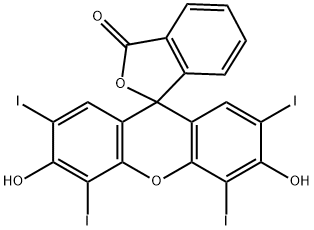
ERYTHROSIN B
- Product NameERYTHROSIN B
- CAS15905-32-5
- CBNumberCB4393694
- MFC20H8I4O5
- MW835.89
- EINECS240-046-0
- MDL NumberMFCD00005044
- MOL File15905-32-5.mol
Chemical Properties
| Melting point: | 303 °C (dec.)(lit.) |
| Boiling point: | 628.3±55.0 °C(Predicted) |
| Density | 2.4391 (estimate) |
| storage temp. | room temp |
| solubility | spirit: soluble |
| form | powder |
| Colour Index | 45430:2 |
| pka | 7.21±0.20(Predicted) |
| color | Red |
| Water Solubility | Soluble in water, spirit, methanol, methyl cellosolve and ethanol. |
| ex/em | λex 529 nm; λem 554 nm |
| ε(extinction coefficient) | ≥102000 at 526-534nm at 0.005g/L (95% Methanol 5% 0.1M Na2CO3) ≥13000 at 310-318nm in 1 M NH4OH at 0.005g/L (95% Methanol 5% 0.1M Na2CO3) ≥32000 at 258-266nm at 0.005g/L (95% Methanol 5% 0.1M Na2CO3) |
| Major Application | diagnostic assay manufacturing hematology histology |
| InChI | 1S/C20H8I4O5/c21-11-5-9-17(13(23)15(11)25)28-18-10(6-12(22)16(26)14(18)24)20(9)8-4-2-1-3-7(8)19(27)29-20/h1-6,25-26H |
| InChIKey | OALHHIHQOFIMEF-UHFFFAOYSA-N |
| SMILES | Oc1c(I)cc2c(Oc3c(I)c(O)c(I)cc3C24OC(=O)c5ccccc45)c1I |
| EPA Substance Registry System | 2',4',5',7'-Tetraiodofluorescein (15905-32-5) |
Safety
| Symbol(GHS) |
 GHS05 |
|||||||||
| Signal word | Danger | |||||||||
| Hazard statements | H314-H290 | |||||||||
| Precautionary statements | P501-P234-P264-P280-P390-P303+P361+P353-P301+P330+P331-P363-P304+P340+P310-P305+P351+P338+P310-P406-P405 | |||||||||
| PPE | Eyeshields, Gloves, type N95 (US) | |||||||||
| Safety Statements | 22-24/25 | |||||||||
| WGK Germany | 2 | |||||||||
| RTECS | LM5940000 | |||||||||
| TSCA | TSCA listed | |||||||||
| HS Code | 2932999099 | |||||||||
| Storage Class | 11 - Combustible Solids | |||||||||
| Toxicity | A food color formerly approved for use in the United States and Europe. It was used primarily in jams and marmalades, maraschino cherries, pickles and relishes, etc. The LD50 in rats is 150 mg/kg, i.p., and 600 mg/kg, p.o. Erythrosine has a variety of actions in vitro due in large measure to its ability to affect biological membranes and lipophilic sites of enzymes. Such data have led to the hypothesis that erythrosine could be neurotoxic, but both clinical and preclinical data have suggested that erythrosine is not likely to be neurotoxic at doses that might be encountered. Two other toxicological issues have been raised with this food color. It has been suggested to be a potential, if weak, carcinogen, and it may also contribute to potential thyroid toxicity resulting from release of iodine. | |||||||||
| NFPA 704: |
|