
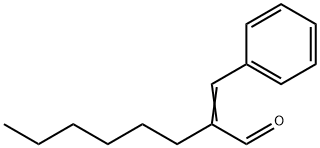
alpha-Hexylcinnamaldehyde
- Product Namealpha-Hexylcinnamaldehyde
- CAS101-86-0
- CBNumberCB2154127
- MFC15H20O
- MW216.32
- EINECS202-983-3
- MDL NumberMFCD00006989
- MOL File101-86-0.mol
Chemical Properties
| Boiling point: | 174-176 °C/15 mmHg (lit.) |
| Density | 0.95 g/mL at 25 °C (lit.) |
| FEMA | 2569 | ALPHA-HEXYLCINNAMALDEHYDE |
| refractive index | n |
| Flash point: | 200 °F |
| storage temp. | -20°C |
| solubility | water: soluble0.005g/L at 25°C |
| form | Oil |
| color | Clear Yellow |
| Odor | at 100.00 %. fresh floral green jasmin herbal waxy |
| Odor Type | floral |
| biological source | synthetic |
| JECFA Number | 686 |
| Henry's Law Constant | 1.0×100 mol/(m3Pa) at 25℃, Dupeux et al. (2022) |
| Stability: | Hygroscopic |
| Major Application | flavors and fragrances |
| Cosmetics Ingredients Functions | PERFUMING |
| InChI | 1S/C15H20O/c1-2-3-4-6-11-15(13-16)12-14-9-7-5-8-10-14/h5,7-10,12-13H,2-4,6,11H2,1H3/b15-12+ |
| InChIKey | GUUHFMWKWLOQMM-NTCAYCPXSA-N |
| SMILES | [H]C(=O)\C(CCCCCC)=C\c1ccccc1 |
| LogP | 5.33 |
| CAS DataBase Reference | 101-86-0(CAS DataBase Reference) |
| NIST Chemistry Reference | Octanal, 2-(phenylmethylene)-(101-86-0) |
| EPA Substance Registry System | .alpha.-Hexylcinnamaldehyde (101-86-0) |
Safety
| Symbol(GHS) |
  GHS07,GHS09 |
|||||||||
| Signal word | Warning | |||||||||
| Hazard statements | H317-H410 | |||||||||
| Precautionary statements | P261-P272-P273-P280-P302+P352-P333+P313 | |||||||||
| Hazard Codes | C,Xi | |||||||||
| Risk Statements | 36/37/38-34-43-52/53 | |||||||||
| Safety Statements | 26-36/37/39-45-36-36/37-61 | |||||||||
| RIDADR | UN 3265 8/PG 3 | |||||||||
| WGK Germany | 2 | |||||||||
| RTECS | GD6560000 | |||||||||
| TSCA | TSCA listed | |||||||||
| HS Code | 2912299000 | |||||||||
| Storage Class | 10 - Combustible liquids | |||||||||
| Hazard Classifications |
Aquatic Acute 1 Aquatic Chronic 2 Skin Sens. 1 |
|||||||||
| Toxicity | The acute oral LD50 value in rats was reported as 3.1 g/kg (2.45-3.75 g/kg) (Moreno, 1971). The acute dermal LD50 value in rabbits was reported as > 3 g/kg (Moreno, 1971). | |||||||||
| NFPA 704: |
|