Chemical Properties
Colorless to light yellow liqui
Uses
Used in the preparation of the lactone fragment of compactin and mevinolin. Chiron in the preparation of
syn-1,3-polyols, dideoxynucleosides, and a spiroacetal cyanohydrin.
General Description
1
H-Pyrazol-3-ylboronic acid hydrate can be used as a reactant in the Suzuki-Miyaura coupling reaction to synthesize pyrazole derivatives by reacting with different aryl halides over the palladium catalyst.
Pharmaceutical Applications
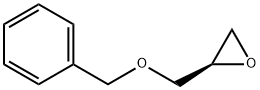
(R)-(-)-Benzyl glycidyl ether can undergo various chemical reactions, such as reduction reactions, coupling reactions, etc., and is used to construct chiral compounds with antibacterial, anti-inflammatory, anti-tumor and other biological activities. Its chiral part can affect the stereoconfiguration and mechanism of action of molecules, thereby regulating the activity and selectivity of drugs.
Safety Profile
Mutation data reported. Whenheated to decomposition it emits acrid smoke andirritating vapors.
Synthesis
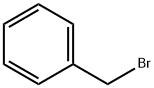
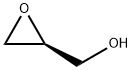
NaH (179 mg, 4.10 mmol, 55% oil solution) was suspended in THF (2 mL) and cooled to 0 °C under argon protection. A THF solution (4 mL) of (S)-oxiran-2-ylmethanol (S1, 200 mg, 2.70 mmol) and benzyl bromide (0.340 mL, 2.86 mmol) were added sequentially. The reaction mixture was heated and stirred at reflux for 19 hours. After completion of the reaction, the reaction was quenched with 0.1 M phosphate buffer (pH 6.5). The product was extracted with ethyl acetate (3×) and the organic layers were combined, washed with saturated brine and dried over anhydrous sodium sulfate. After concentration under reduced pressure, the residue was purified by fast column chromatography on silica gel (eluent: hexane/ethyl acetate = 10/1) to afford (R)-benzyloxymethylepoxane (S21) as a colorless oil (196 mg, 44%).1H NMR (300 MHz, CDCl3) δ = 2.62 (dd, J1 = 2.5 Hz, J2 = 5.0 Hz, 1H), 2.80 (dd, J1 = 3.0 Hz, J2 = 5.0 Hz, 1H), 3.19 (dd, J1 = 2.5 Hz, J2 = J3 = 3.0 Hz, J4 = 5.5 Hz, 1H), 3.44 (dd, J1 = 5.5 Hz, J2 = 11.5 Hz, 1H), 3.77 (dd, J1 = 3.0 Hz, J2 = 11.5 Hz, 1H), 4.57 (d, J = 12.0 Hz, 1H), 4.61 (d, J = 12.0 Hz, 1H), 7.25-7.38 (m, 5H); 13C NMR (75 MHz, CDCl3) δ = 44.3, 50.8, 70.8, 73.3, 127.7, 128.4, 137.8; HRMS (EI) m/z 164.0825 (calculated for C10H12O2, M+ 164.0837).
Purification Methods
This ether in EtOAc is dried (Na2SO4), then purified by flash chromatography using pet ether/EtOAc (5:1) as eluent. The ether distils through a short path distillation apparatus (Kügelrohr) as a colourless liquid. Alternatively, dissolve it in CHCl3, wash it with H2O, dry (Na2SO4), evaporate and purify by silica gel chromatography. [Anisuzzamen & Owen J Chem Soc 1021 1967, Takano et al. Heterocycles 1 6 381 1981, Lipshutz et al. Org Synth 69 82 1990, Takano et al. Synthesis 539 1989, Honda et al. Chem Pharm Bull Jpn 39 1385 1991, Beilstein 12 IV 2277.]
References
[1] Collection of Czechoslovak Chemical Communications, 2009, vol. 74, # 5, p. 651 - 769
[2] Chemistry - A European Journal, 2010, vol. 16, # 47, p. 14074 - 14082
[3] Tetrahedron, 2002, vol. 58, # 25, p. 5109 - 5117
[4] Bioorganic and Medicinal Chemistry, 2007, vol. 15, # 2, p. 663 - 677
[5] European Journal of Organic Chemistry, 2005, # 22, p. 4773 - 4788