Description
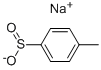
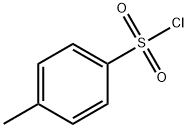
Sodium p-toluenesulfinate (STS, molecular formula C7H7NaO2S) is an organic synthesis intermediate with strong nucleophilicity and reducing properties, and is mainly used as a reaction reagent/building block. In a copper-catalyzed system, it can undergo a coupling reaction with aryl diazonium salts to synthesize diaryl sulfones. Its reaction with benzoyl chloride produces benzoic anhydride in good yield. In addition, it can also react with acetyl chloride to produce acetic anhydride, p-toluenesulfinyl chloride, thiosulfonate, and sodium p-toluenesulfonate [1-2]. Furthermore, multiple studies have shown that STS is effective as an antioxidant for dental adhesives. It can enhance the bonding durability of general adhesives on acid-etched dentin [3]. It should be noted that sodium p-toluenesulfinate is easily confused with sodium p-toluenesulfonate. Sodium p-toluenesulfonate (molecular formula C7H9NaO3S) is mainly used as an industrial detergent, water-soluble growth promoter, or dye intermediate.
Chemical Properties
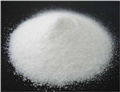
White powder
Uses
Sodium p-toluenesulfinate can be used as intermediate of pharmaceutical and dispersal dyes, and also can be used as curing agent of grouting material.
Uses
p-Toluenesulfinic acid sodium salt is used as an intermediate for the preparation of pharmaceuticals and dispersal dyes. It acts as a curing agent of grouting material. It is also used as a discharge medium of dyes and pigments. Further, it serves as a chemical intermediate in the production of fluorescent pigments and fabric adhesive. In addition to this, it is used as an electroplating brightening agent and curing agent.
Purification Methods
Recrystallise the salt from water (to constant UV spectrum) and dry it under vacuum, or extract it with hot *benzene, then dissolve it in EtOH/H2O and heat with decolorising charcoal. The solution is filtered and cooled to give crystals of the dihydrate.[Beilstein 11 I 718.]
References
[1] Gund, S. H., Shelkar, R. S., & Nagarkar, J. M. (2015). Copper catalyzed synthesis of unsymmetrical diaryl sulfones from an arenediazonium salt and sodium p-toluenesulfinate†. RSC Advances, 77, 62926–62930. https://doi.org/
10.1039/C5RA10291J[2] KobayashiMichio. (1966). Organic Sulfur Compounds. III. The Reactions of Toluenesulfinic Acid with Acyl Chlorides. Bulletin of the Chemical Society of Japan, 39 1, 967–970. https://doi.org/
10.1246/bcsj.39.967[3] Yorichika Shioya. (2021). Sodium p-Toluenesulfinate Enhances the Bonding Durability of Universal Adhesives on Deproteinized Eroded Dentin. Polymers. https://doi.org/
10.3390/polym13223901