Chemical Properties
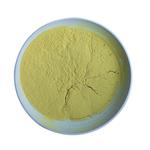
Slightly yellow low melting solid or liquid
Uses
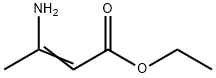
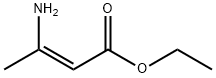
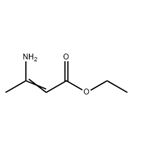
Ethyl 3-Aminocrotonate is used as a reagent to synthesize Nitrendipine (N490150), a calcium channel antagonist that is used to treat patients with hypertension. Ethyl 3-Aminocrotonate is also used as a reagent to synthesize (S)-Felodipine (F232370), a calcium entry blocker that has antihypertensive properties.
Synthesis
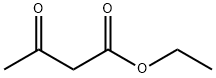
General procedure for the synthesis of ethyl 3-aminocrotonate from ethyl acetoacetate: β-keto ester (1.0 eq.), ammonium acetate (3.0 eq.), and acetic acid (dropwise) were dissolved in dry toluene (6 mL) in a 10 mL reaction glass vial containing a stirring magnet and a molecular sieve. The vial was tightly sealed with an Aluminum-Teflon convoluted cap and the mixture was microwaved at 140 °C for 20 min at 60 W power. After completion of the reaction, it was cooled to 50 °C by gas injection. The crude reaction mixture was partitioned between ethyl acetate (15 mL) and saturated sodium bicarbonate solution (15 mL), and the aqueous layer was extracted with ethyl acetate (3 x 15 mL). The organic layers were combined, dried with anhydrous sodium sulfate, filtered and concentrated under reduced pressure. The crude product was purified by rapid chromatography on silica gel.Synthesis of ethyl 3-aminobut-2-enoate (6a): ethyl 3-(2-fluorophenyl)-3-oxopropanoate 5a (1.0 eq.), ammonium acetate (4.0 eq.), and acetic acid (7 drops) were reacted under the above conditions. Rapid chromatographic purification using hexane/ethyl acetate (80:20 to 70:30) as eluent gave an analytically pure product in 89% yield.1H NMR (CDCl3, 300 MHz) δ (ppm): 1.24 (t, 3H, J=7.36 Hz), 3.51 (s, 3H), 4.09 (q, 2H, J=7.28 Hz). 4.60 (s, 1H).
References
[1] Comptes Rendus Chimie, 2011, vol. 14, # 5, p. 511 - 515
[2] Patent: WO2012/147103, 2012, A2. Location in patent: Page/Page column 7
[3] Bulletin of the Academy of Sciences of the USSR, Division of Chemical Science (English Translation), 1986, vol. 35, p. 1438 - 1442
[4] Izvestiya Akademii Nauk SSSR, Seriya Khimicheskaya, 1986, # 7, p. 1586 - 1592
[5] European Journal of Medicinal Chemistry, 2018, vol. 155, p. 946 - 960