Chemical Properties
Tan Solid
Uses
1,2,3,4-Tetrahydro-β-carboline is a mitotic kinesin inhibitor as novel anti-cancer agent. It is used in the study of neurodegenerative diseases.
Application
1,2,3,4-Tetrahydro-9H-pyrido[3,4-b]indole was employed in alkaloid synthesis and in studies on neurodegenerative diseases.
Reactant for synthesis of the indolyl-β-carboline alkaloid eudistomin U via IBX mediated room temperature oxidative aromatization
Reactant for preparation of neuroprotective HDAC6 inhibitors
Reactant for preparation of aminofuranopyrimidines as EGFR and Aurora A kinase inhibitors
Reactant for preparation of inhibitors of CDK4
Reactant for preparation of tetrahydrocarboline derivatives of as human 5-HT5A receptor ligands
Reactant for preparation of 5-(diaminomethyl)-2,4-aminopyrimidines as dihydrofolate reductase inhibitors and antibacterial agents
Definition
ChEBI: 2,3,4,9-tetrahydro-1H-pyrido[3,4-b]indole is a member of beta-carbolines.
General Description
Ozonolysis of the enamine bond of 1,2,3,4-tetrahydro-9
H-pyrido[3,4-
b]indole derivatives was studied.
Synthesis
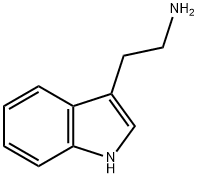
1.5 g of tryptamine was dissolved in a mixed acetic acid/methanol solvent (AcOH/MeOH = 10:1, v/v) and 345 mg of paraformaldehyde was slowly added. The reaction mixture was stirred at 80 °C for 30 min. After completion of the reaction, the progress of the reaction was monitored by TLC. The reaction system was slowly poured into dilute aqueous ammonia solution (NH4OH/H2O = 1:1, v/v, 80 ml) and the pH was adjusted to 10. The organic phases were combined by extracting three times with a solvent mixture of dichloromethane/methanol (CH2Cl2/MeOH = 10:1, v/v). The organic phase was dried with anhydrous sodium sulfate, filtered and concentrated. The crude product was purified by silica gel column chromatography with dichloromethane/methanol (CH2Cl2/MeOH = 10:1, v/v) as eluent to give 1.6 g of Intermediate A in 98% yield. The product was a light yellow solid, stable at room temperature.
in vivo
Tetrahydro-β-carboline (20 μg; i.c.v.) increases the serotonin levels in the same part of the brain in rats[1].
| Animal Model: | 180-200g female Sprague-Dawley rats[1] |
| Dosage: | 20 μg |
| Administration: | Intraventricular injection |
| Result: | Increased of serotonin levels in the same part of the brain whereas the monoamine oxidase activity was not altered. |
IC 50
serotonin: 6.1 μM (Ki)
References
[1] CHRISTIAN O ALBERTO Michiru H Robert B Trask. Dopamine acts as a partial agonist for α2A adrenoceptor in melanin-concentrating hormone neurons.[J]. Journal of Neuroscience, 2011, 31 29: 10671-10676. DOI:
10.1523/JNEUROSCI.6245-10.2011.
[2] IAIN M. MCDONALD. 2,7-Dioxo-2,3,4,5,6,7-hexahydro-1H-benzo[h][1,4]diazonine as a New Template for the Design of CCK2 Receptor Antagonists[J]. Journal of Medicinal Chemistry, 2000, 43 19: 3518-3529. DOI:
10.1021/jm000960w.
[3] Rommelspacher, H., Bade, P., Coper, H., et al. Inhibition of the reuptake of serotonin by tryptoline. Naunyn Schmiedebergs Arch. Pharmacol. 292(1), 93-95 (1976).
[4] Pannier, L., and Rommelspacher, H. Actions of tetrahydronorharmane (tetrahydro-β-carboline) on 5-hydroxytryptamine and dopamine mediated mechanisms. Neuropharmacology 20(1), 1-8 (1981).
[5] Rommelspacher, H., Kauffmann, H., Cohnitz, C.H., et al. Pharmacological properties of tetrahydronorharmane (tryptoline). Naunyn Schmiedebergs Arch. Pharmacol. 298(2), 83-91 (1977).

![1,2,3,4-Tetrahydro-9H-pyrido[3,4-b]indole Structure](https://www.chemicalbook.com/CAS/GIF/16502-01-5.gif)

![1,2,3,4-TETRAHYDRO-9H-PYRIDO[3,4-B]INDOLE](/CAS/GIF/16502-01-5.gif)