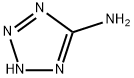
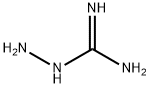
Chemical Properties
A white or off-white crystalline powder with pronounced alkaline properties; it reacts with common acids to form salts.
Uses
5-Aminotetrazole (5-AT) is an important class of nitrogen-containing heterocyclic compounds and serves as a widely used and highly efficient synthetic unit or building block. 5-AT exhibits a variety of biological activities (such as antiviral, antitumour, antibacterial and antihistamine activities). Furthermore, this structure forms the core skeleton of many known drugs (such as glutamate receptor modulators and HIF-2 inhibitors, etc.) (see figure below) [1]. In addition, it has extensive applications in coordination chemistry and materials science (including explosives and photographic materials). As a high-nitrogen-energy ligand, 5-AT can be used in the preparation of novel metal-organic frameworks (MOFs) [2].

Application
5-Aminotetrazole can be used as a propellant in pyrotechnic products, such as gas generators, airbags and smoke signal devices. Owing to its high nitrogen content (82 per cent) and high heat of combustion (208 kJ·mol⁻¹), it is often mixed with an oxidiser in practical applications.
Hazard
Moderately toxic. An unstable material;
explodes with KOH.
Flammability and Explosibility
Not classified
Synthesis
5-Aminotetrazole (5-AT) is synthesized by reacting cyanamide or dicyandiamide with an azide salt at high temperature in the presence of an acidic reagent (such as boric acid). The pKa value of this acidic reagent is between 3 and 7. The reaction solution is heated to above 75°C, preferably at reflux temperature (usually above 90°C). No large amounts of azide acid are generated during the reaction. After the reaction is complete, a strong acid (such as hydrochloric acid) is added to the reaction solution to acidify it, lowering the pH to below 3, causing the generated 5-AT to be protonated and precipitated. Finally, the pure 5-AT product is separated by conventional methods such as filtration and washing. The synthetic route is shown below:

References
[1] de Jesus, I. S., Gomes, A. T., Sande, I., & Cunha, S. (2024). Three-Component Synthesis of 1-Substituted 5-Aminotetrazoles Promoted by Bismuth Nitrate. The Journal of Organic Chemistry, 63 1. https://doi.org/
10.1021/acs.joc.4c01727[2] Yanzhao Hao . (2024). Construction of energetic metal-organic frameworks based on 5-aminotetrazole. Inorganic Chemistry Communications, 164, Article 112354. https://doi.org/
10.1016/j.inoche.2024.112354