Uses
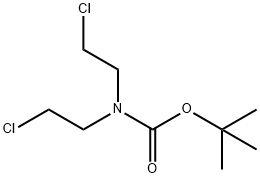
Tert-butyl bis(2-chloroethyl)carbamate is a derivative of bis(2-chloroethyl)amine, which is used as a medicinal chemistry and organic synthesis intermediate, where the Boc group in the structure is readily removed to obtain the active carboxyl group in the organic synthesis transformation.
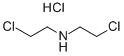
And bis(2-chloroethyl)amine is an anticancer drug that acts as a DNA alkylating agent. It induces apoptosis in human hepatocellular carcinoma cells. It has been shown to be effective against drug-resistant mutants and is used in the treatment of tuberculosis.
Synthesis
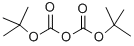
In a 500 mL three-necked flask, 100 g of bis(2-chloroethyl)amine hydrochloride (IV) was added and dissolved in 300 mL of dichloromethane, followed by the addition of 113 g of triethylamine, and the slow dropwise addition of 147 g of di-tert-butyl dicarbonate (Boc anhydride) with continuous stirring, and the reaction was carried out for 4-6 hours. After completion of the reaction, 200 mL of purified water was added for liquid-liquid separation, followed by washing the organic phase with 200 mL of saturated sodium chloride solution and drying the organic layer with anhydrous sodium sulfate. After drying, concentration under reduced pressure afforded 133 g of tert-butyl N,N-bis(2-chloroethyl)carbamate (V) in 98% yield.
References
[1] Tetrahedron, 2004, vol. 60, # 22, p. 4875 - 4878
[2] Patent: US2003/187020, 2003, A1
[3] Patent: WO2006/46024, 2006, A1. Location in patent: Page/Page column 146
[4] Patent: WO2007/125321, 2007, A2. Location in patent: Page/Page column 140-141
[5] Patent: US2003/229067, 2003, A1. Location in patent: Page 26