Chemical Properties
white to light yellow crystal powde
Uses
Reactant involved in synthesis of:
- Organic field-effect transistors based on organic semiconductors containing diazaboroles
- Cycloparaphenylenes via Suzuki coupling
- 1,3,2-Diazaboroine derivatives for organic thin-film transistor applications
- Back-to-back coupled 2,6-bis(triazol-1-yl)pyridine molecules
- Rectangular host via electrochemical reactions with methylaquacobaloxime and diamine
- Arylboronates from reactions with catechol, dihydroxynaphthalene and diaminobenzenedithiol for use as organic field-effect transistors and light emitting diodes
Synthesis
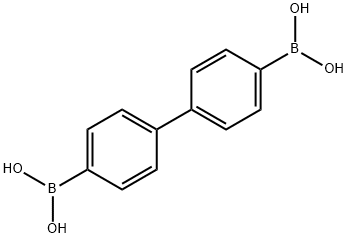
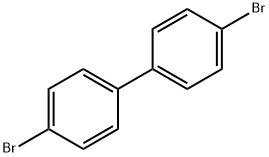
The general procedure for the synthesis of 4,4'-biphenyl diboronic acid from 4,4'-dibromobiphenyl was as follows: to a solution of 4,4'-dibromo-1,1'-biphenyl (5.00 g, 16.03 mmol) in anhydrous THF (100 mL) was added slowly and dropwise n-butyllithium (1.0 M hexanes solution, 40.1 mL, 64.1 mmol) at -78 °C, and was stirred for 1 hour. Subsequently, the reaction mixture was slowly warmed to -30 °C and trimethyl borate (4.83 mL, 43.3 mmol) was added dropwise and then stirring was continued for 1 hour at room temperature. Upon completion of the reaction, the reaction mixture was acidified to pH=2 with 1.5 N HCl. The resulting precipitate was filtered to afford 4,4'-biphenyldiboronic acid in the form of an off-white solid (2.5 g, 10.34 mmol, 64.5% yield). The structure of the product was confirmed by NMR (DMSO-d6, δ=2.50 ppm, 400 MHz): δ 8.06 (broad peak, 4H), 7.88 (double peak, J=8.53 Hz, 4H), 7.65 (double peak, J=8.4 Hz, 4H).
References
[1] Patent: WO2015/5901, 2015, A1. Location in patent: Page/Page column 490
[2] Chemistry Letters, 2008, vol. 37, # 11, p. 1122 - 1123
[3] Journal of Materials Chemistry, 2011, vol. 21, # 18, p. 6607 - 6613
[4] Journal of Materials Chemistry, 2012, vol. 22, # 10, p. 4502 - 4510
[5] Angewandte Chemie - International Edition, 2014, vol. 53, # 51, p. 14144 - 14148