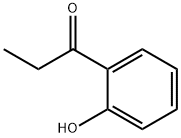
Preparation
Obtained by Fries rearrangement of phenyl propionate
with aluminium chloride in refluxing carbon disulfide , then at 130–150° for 2–3 h after solvent elimination (32–35%)
with aluminium chloride in chlorobenzene using microwave irradiation for 3 min at 106° (28%)
with aluminium chloride in nitrobenzene at 50° for 18 h (16%) or at 20° for 48 h (10%)
with aluminium chloride in nitromethane at 20° for 7 days (20%)
with aluminium chloride in heptane at 80–90° for 7 h (53%) or in tetrachlo- roethane at 95° for 5 h (43%)
with aluminium chloride without solvent at 250° for 5 min or at 180–200° for 15 min (76–78%), at 140–160° (32–35%), at 140°
with zirconium chloride in o-dichlorobenzene at 120° for 3 h (83%)
with titanium tetrachloride in o-dichlorobenzene at 150° for 1 h (62%) , in nitromethane at 20° for 7 days (13%) or without solvent at 50° for 10 h (30%)
with titanium tetrabromide in o-dichlorobenzene at 150° for 1 h (60%)
with stannic chloride at 50° for 3 h (25%)
with boron trifluoride at 120–135° for 15 min (15%)
with zinc chloride at 180–200° for 15 min (10%)
with polyphosphoric acid at 100° (13%)
Also obtained by Friedel–Crafts acylation of phenol with propionyl chloride in the presence of aluminium chloride (40%), at 120–130° for 1 h (45%) according to the method
Also obtained by acylation of phenol with propionic acid
in the presence of boron trifluoride at 165° for 1 h (45%) or at 80° for 2 h (8%)
in the presence of polyphosphoric acid at 100° for 10 min (by-product)
in the presence of zinc chloride at 160° for 1 h
Also obtained by isomerization of 4-hydroxypropiophenone with aluminium chloride (1.5 equiv) at 165° for 1 h (40%) or at 180–200° for 15 min (55%)
Also obtained by demethylation of 2-propionylanisole with fuming hydrochloric acid (d = 1.19) in a sealed tube at 110° for 6 h
Also obtained (by-product) by heating 3-tert-butyl-4-hydroxypropiophenone with aluminium chloride at 170° for 15 min (13%)
Also obtained by treatment of 2,3-dimethylchromone with sodium ethoxide in boiling ethanol for 30 h according to the method
Also obtained from 2-allylphenol by treatment with perbenzoic acid in ethyl ether, first at 0°, then between 0° and 25° for 24 h (78%)
Also obtained by reaction of 2-bromophenyl propionate in a ethyl ether/hexane/THF mixture at low temperature (78 to 95°) with sec-butyllithium to give, after hydrolysis, the titled ketone (metal-promoted Fries rearrangement) (17%)
Also obtained by reaction of ethylmagnesium bromide
with 2-hydroxybenzamide in boiling benzene, followed by hydrolysis (30%)
with 2-hydroxy-N,N-diethylbenzamide in boiling benzene, followed by hydrolysis (82–84%)
Also isolated by heating of 1-(o-hydroxyphenyl)cyclopropyltrimethylam-monium iodide for 1 h at 140° with 1.5 equiv of N,N-diisopropylethylamine (not water-free) (38%)
Also obtained by hydrolysis of 2-(1-methyliminopropyl)phenol (4aa) with aqueous acetic acid/THF at 40° for 4 h (86%)
Also obtained by photolysis of phenyl propionate in water or in solution containing b-cyclodextrine (254 nm) at 25° for 2 h
Also obtained by treatment of 2-(1-hydroxypropyl)phenol with MnO2 in methylene chloride for 7 h at r.t.
References
[1] Prosen, E., Ward, O. P., Collins, S., Dewdney, N. J., Hong, Y., & Wilcocks, R. (1993). Enantiospecific Production of S-(-)-2-Hydroxypropiophenone Mediated by Benzoylformate Decarboxylase from Acinetobacter Calcoaceticus. Biocatalysis, 8(1), 21–29.
https://doi.org/10.3109/10242429309030953 [2] Kordesedehi, R., Shahpiri, A., Asadollahi, M. A., Biria, D., & Nikel, P. I. (2024). Enhanced chaotrope tolerance and ( S )-2-hydroxypropiophenone production by recombinant Pseudomonas putida engineered with Pprl from Deinococcus radiodurans. Microbial Biotechnology, 17(3).
https://doi.org/10.1111/1751-7915.14448 [3] Kordesedehi, R., Asadollahi, M. A., Shahpiri, A., Biria, D., & Nikel, P. I. (2023). Optimized enantioselective (S)-2-hydroxypropiophenone synthesis by free- and encapsulated-resting cells of Pseudomonas putida. Microbial Cell Factories, 22(1).
https://doi.org/10.1186/s12934-023-02073-7