Description
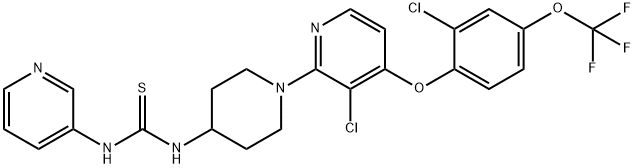
DO264 is an inhibitor of α/β-hydrolase domain-containing protein 12 (ABHD12; IC
50 = 11 nM). It inhibits ABHD12-dependent hydrolysis of lysophosphatidylserine (lyso-PS) in mouse brain membrane lysates (IC
50 = 2.8 nM) and human THP-1 cells. DO264 increases levels of chemokine (C-C motif) ligand 3 (CCL3), CCL4, TNF-α, and IL-1β in M1-polarized THP-1 macrophages. It potentiates ferroptotic cell death induced by the glutathione peroxidase 4 (GPX4) inhibitor RSL3 in HT1080 fibrosarcoma and SU-DHL-5 B cell lymphoma cells when used at a concentration of 1 μM.
In vivo, DO264 (30 mg/kg per day for four weeks) increases levels of 1-stearoyl-2-hydroxy-
sn-glycero-3-PS, 1-arachidonoyl-2-hydroxy-
sn-glycero-3-PS, 1-docosanoyl-2-hydroxy-
sn-glycero-3-PS, 1-stearoyl-2-arachidonoyl-
sn-glycero-3-PS, and 1-oleoyl-2-arachidonoyl-
sn-glycero-3-PS in mouse brain. It increases levels of CCL2, CCL3, and CCL5 in bronchoalveolar lavage fluid (BALF) and decreases survival in a mouse model of infection with lymphocytic choriomeningitis virus (LCMV) clone 13 when administered at a dose of 30 mg/kg.
in vivo
Mice treated with DO-264 display dose-dependent increases in brain lyso-PS and 20:4 PS content that are qualitatively similar to the changes observed in ABHD12–/– mice. DO-264-treated mice, however, show minimal impairment in auditory function following four weeks of drug exposure. Both ABHD12–/– and DO-264-treated mice display exacerbated immunopathology following infection with the lymphocytic choriomeningitis virus (LCMV) clone 13, resulting in severe inflammatory lung damage, heightened chemokine production, and, in some cases, death[1].
References
[1] DAISUKE OGASAWARA*. Discovery and Optimization of Selective and in Vivo Active Inhibitors of the Lysophosphatidylserine Lipase α/β-Hydrolase Domain-Containing 12 (ABHD12)[J]. Journal of Medicinal Chemistry, 2019, 62 3: 1643-1656. DOI:
10.1021/acs.jmedchem.8b01958[2] DAISUKE OGASAWARA. Selective blockade of the lyso-PS lipase ABHD12 stimulates immune responses in vivo[J]. Nature chemical biology, 2018, 14 12: 1099-1108. DOI:
10.1038/s41589-018-0155-8