Description
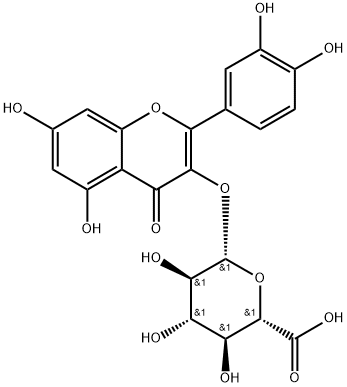
Quercetin 3-
O-glucuronide is a pharmacologically active flavonol glucuronide isolated from
H. perforatum (St. John’s wort) that inhibits the α
2c adrenergic receptor (K
i = 4,060 nM in hα
2c preparations). Quercetin 3-
O-glucuronide (0.6 mg/kg) reduced the time rats spent immobile in the forced swim test, suggesting antidepressant-like properties, when given either acutely or chronically. It also reduced open field stress-induced hyperthermia in mice (at 1.2 mg/kg).
Chemical Properties
Yellow Solid
Uses
Quercetin 3-O-β-D-Glucuronide is the major metabolite of Quercetin (Q509500).
Definition
ChEBI: Miquelianin is a quercetin O-glycoside that consists of quercetin attached to a beta-D-glucuronopyranosyl moiety at position 3 via a glycosidic linkage. Isolated from Salvia and Phaseolus vulgaris, it exhibits antioxidant and antidepressant activities. It has a role as a metabolite, an antioxidant and an antidepressant. It is a beta-D-glucosiduronic acid and a quercetin O-glycoside.
Synthesis
Overnight cultures of E. coli containing specific genes were inoculated into 50 mL of fresh LB medium containing appropriate antibiotics. Isopropyl -D-1-thiogalactopyranoside (IPTG) was added to the mixture to a final concentration of 1 mM. the transformants were incubated for an additional 20 h at 18C. The cells were then incubated with the antibiotic for a further 20 h. The transformants were then incubated with the antibiotic. Cells were harvested by centrifugation and resuspended in fresh M9 medium containing 2% glucose and antibiotics and 1 mM isopropyl -D-1-thiogalactopyranoside. The cell density was adjusted to an OD600 value of 2. A total reaction volume of 2 mL was maintained in a test tube (14 mm x 145 mm). one hundred micromoles of lignocaine was added to the reaction mixture. The mixture was incubated at 25C for 1.5 hrs. An additional 100 M lignocaine was added to the reaction mixture. The mixture was incubated for another 1.5 hours. 200 M lignocaine was added to the mixture to determine the optimal cell concentration. 2 hours later, another 200 M lignocaine was added to the mixture. The reaction mixture was incubated for 2 hours. The cell density was adjusted to an OD600 value of 3. 200 M quercetin was added to the reaction for 2 hours. One hundred micromoles of quercetin was added to the mixture. The mixture was shaken at 30C for 1.5 h to obtain 2-(3,4dihydroxyphenyl)-5,7-dihydroxy-4-oxo-4H-1-benzopyran-3-yl-BETA-D-glucopyranosiduronic acid
in vivo
Miquelianin treatment, compared to vehicle-control treatment, significantly improves AD-type deficits in hippocampal formation basal synaptic transmission and long-term potentiation[3].
References
[1] A NAHRSTEDT V B. Biologically active and other chemical constituents of the herb of Hypericum perforatum L.[J]. Pharmacopsychiatry, 1997, 30 Suppl 2: 129-134. DOI:
10.1055/s-2007-979533[2] ADOLF NAHRSTEDT* Veronika B. Lessons Learned from Herbal Medicinal Products: The Example of St. John’s Wort⊥[J]. Journal of Natural Products , 2010, 73 5: 1015-1021. DOI:
10.1021/np1000329[3] V BUTTERWECK. Flavonoids from Hypericum perforatum show antidepressant activity in the forced swimming test.[J]. Planta medica, 2000, 66 1: 3-6. DOI:
10.1055/s-2000-11119[4] OLIVER GRUNDMANN Veronika B Olaf Kelber. Effects of St. John’s wort extract and single constituents on stress-induced hyperthermia in mice.[J]. Planta medica, 2006, 72 15: 1366-1371. DOI:
10.1055/s-2006-951710