Synthesis
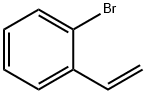
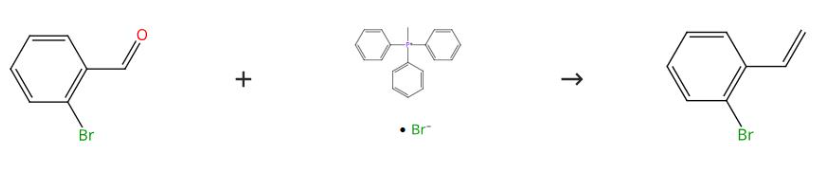
2-Bromostyrene was synthesized by the reaction of 2-bromobenzaldehyde and methyltriphenylphosphonium bromide. The synthetic method is as follows:
Butyllithium (1.6M in hexane, 74.3 mL, 119 mmol, Fluka 20160) was added dropwise at 0°C under argon to a solution of methyltriphenylphosphonium bromide (42.4 g, 119 mmol, Avocado Chemicals 98+%) in dry THF (120 mL). The reaction mixture was stirred at 0°C for 15 minutes. 2-Bromobenzaldehyde (12.5 mL, 108 mmol, ABCR 98%) was slowly added dropwise to the orange mixture at 0°C, giving a viscous white slurry, which was vigorously stirred at room temperature for 3.5 hours. The reaction was quenched with brine, and the mixture was extracted with ethyl acetate. The combined organic layers were washed with brine, dried over magnesium sulfate, and concentrated under reduced pressure. Rapid chromatography on silica gel (cyclohexane/MMTBE 50:1) yielded 2-bromostyrene in a colorless liquid form (15.6 g, 85.2 mmol, 79%). Rf = 0.61 (cyclohexane/MMTBE 9:1).
Uses
2-Bromostyrene is used as a cross linking agent in fire-resistant bromostyrene-crosslinked polyesters. Further, it is used to prepare trans-1-(2-bromophenyl)-2-(3-bromophenyl)ethene by reacting with 1-bromo-3-iodo-benzene, involving palladium(II) acetate as catalyst.