Description
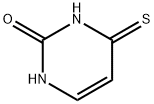
4-Thiouracil is a site-specific, photoactivatable probe used to detect RNA structures and nucleic acid-nucleic acid contacts. It absorbs ultraviolet light >300 nm and, in the presence of oxygen, acts as an energy donor to produce singlet oxygen by triplet-triplet energy transfer. The highly reactive oxygen species then reacts readily with 4-thiouracil, leading to the production of uracil and uracil-6-sulfonate, which is fluorescent at a wavelength of ~390 nm. 4-Thiouracil is used as a
T. gondii uracil phosphoribosyltransferase substrate to produce 4-thiouridine monophosphate, which can ultimately be incorporated into RNA.
Chemical Properties
yellow powder
Uses
4-Thiouracil is suitable reagent employed in Schneider′s media for the embryos during RNA extraction. It may be employed as reagent for the Northwestern blotting technique.
Uses
4-Thiouracil is a derivative of Uracil (U801000), which is a nitrogenous base in RNA nucleic acid. 4-Thiouracil is used for tagging in cell type-specific RNA isolation from intact complex tissues.
References
[1] MICHAEL R MILLER. TU-tagging: cell type–specific RNA isolation from intact complex tissues[J]. Nature Methods, 2009, 6 6: 439-441. DOI:
10.1038/nmeth.1329[2] XIAORAN ZOU. Photophysical and Photochemical Properties of 4-Thiouracil: Time-Resolved IR Spectroscopy and DFT Studies[J]. The Journal of Physical Chemistry B, 2014, 118 22: 5864-5872. DOI:
10.1021/jp501658a[3] GUSTI M ZEINER. RNA analysis by biosynthetic tagging using 4-thiouracil and uracil phosphoribosyltransferase.[J]. Methods in molecular biology, 2008, 419: 135-146. DOI:
10.1007/978-1-59745-033-1_9