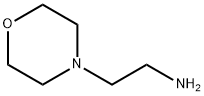
Chemical Properties
clear colorless to pale yellow liq. after melting
Uses
4-(2-Aminoethyl)morpholine is widely used in biomedical applications as this moiety serves as an important lysosome-targeting group. Some of its applications include:
- Synthesis of the lysosome-targetable fluorescent probe for hydrogen sulfide imaging in living cells.
- Synthesis of 1,8-naphthalimide conjugated Troger′s bases as deoxyribonucleic acid (DNA) targeting fluorescent probe.
- Synthesis of intramolecular charge transfer-photoinduced electron transfer-fluorescence resonance energy transfer (ICT-PET-FRET) fluorescent probe for monitoring pH changes in living cells.
- It is also used as a precursor to synthesize a variety of antimicrobial agents.
Uses
4-(2-Aminoethyl)morpholine is used as a ligand and reacts with nickel(II) nitrite to form trans-bis[4-(2-aminoethyl)morpholine]dinitronickel(II).
Definition
ChEBI: 4-2-Aminoethyl-morpholine is a member of morpholines.
Synthesis Reference(s)
Journal of Medicinal Chemistry, 34, p. 1805, 1991
DOI: 10.1021/jm00110a008
Synthesis
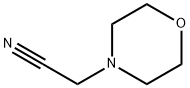
General procedure for the synthesis of N-(2-aminoethyl)morpholine from 2-morpholinoacetonitrile: LiAlH4 (3.19 g, 84 mmol) was added to anhydrous THF (35 mL) in a single step under ice bath conditions. The reaction mixture was stirred at 0 °C for 20 min, followed by the dropwise addition of 2-morpholino-substituted acetonitrile (3.50 g, 28 mmol) to a solution of anhydrous THF (10 mL). After the dropwise addition, the reaction mixture was heated to reflux for 3 hours. After completion of the reaction, the mixture was cooled to 0 °C and water (20 mL) was slowly added to quench the reaction. After filtration to remove insoluble material, the filtrate was concentrated in vacuum to give N-(2-aminoethyl)morpholine as a yellow oil (2.62 g, 72% yield).
References
[1] Patent: WO2014/12360, 2014, A1. Location in patent: Paragraph 00363
[2] Patent: US2015/87639, 2015, A1. Location in patent: Paragraph 0650
[3] Patent: TWI607995, 2017, B. Location in patent: Page/Page column 146
[4] Bulletin de la Societe Chimique de France, 1955, p. 218
[5] Patent: CN108658937, 2018, A. Location in patent: Paragraph 0151; 0152; 0231; 0232