Synthesis
In a dry 250 mL reaction flask, anhydrous triethylamine (655 μmol) was added to a solution of bromo-tris(pyrrolidine)phosphine hexafluorophosphine (2.19 g) and 1-hydroxy-7-azabenzyltriazole (4.70 mmol) in anhydrous dichloromethane (8 mL). The resulting reaction mixture was stirred at room temperature for 2 hours. After the reaction was complete, anhydrous diethyl ether was added to the reaction system, and a solid was observed to precipitate. The precipitate was collected on a filter and washed successively with water (3 x 25 mL) and anhydrous diethyl ether (2 x 25 mL). Finally, the precipitate was recrystallized from acetone/diethyl ether to obtain the target product.
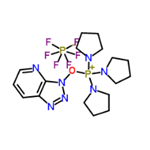
![Synthetic route of (3-Hydroxy-3H-1,2,3-triazolo[4,5-b]pyridinato-O)tri-1-pyrrolidinylphosphonium hexafluorophosphate](/NewsImg/2023-06-19/6382276420950870801220790.jpg "Synthetic route of (3-Hydroxy-3H-1,2,3-triazolo[4,5-b]pyridinato-O)tri-1-pyrrolidinylphosphonium hexafluorophosphate")
Figure: Synthetic route of (3-Hydroxy-3H-1,2,3-triazolo[4,5-b]pyridinato-O)tri-1-pyrrolidinylphosphonium hexafluorophosphate
Chemical Properties
(3-Hydroxy-3H-1,2,3-triazolo[4,5-b]pyridinato-O)tri-1-pyrrolidinylphosphonium hexafluorophosphate is white to off-white crystalline powder
Uses
PyAOP is a phosphonium salt used as a coupling reagent in solid-phase peptide synthesis, without undergoing side reactions with the amino terminus. PyAOP is a derivative of HOAt (H805070).
Uses
(3-Hydroxy-3H-1,2,3-triazolo[4,5-b]pyridinato-O)tri-1-pyrrolidinylphosphonium hexafluorophosphate is used as a coupling reagent in solid phase peptide synthesis. It is preferred over HATU, because it does not side react at the N-terminus of the peptide. Compared to the HOBt derivates, PyAOP (and HOAt in general) are more reactive due to the additional nitrogen.
reaction suitability
reaction type: Coupling Reactions

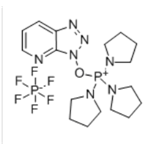
![(3-Hydroxy-3H-1,2,3-triazolo[4,5-b]pyridinato-O)tri-1-pyrrolidinylphosphonium hexafluorophosphate Structure](https://www.chemicalbook.com/CAS/GIF/156311-83-0.gif)