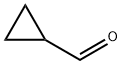
Description
Cyclopropanecarboxaldehyde (CPCA) is an organic molecule containing a cyclopropyl tricyclic ring and an aldehyde group (–CHO), and belongs to the family of compounds containing a formyl (HCO) structural unit. This molecule exists in two conformational isomers: the cis conformation (where the carbonyl group C=O is positioned above the cyclopropyl ring) and the trans conformation (where the carbonyl group C=O points away from the cyclopropyl ring), as shown in the figure below:

This substance is primarily used as a candidate molecule in astrophysical surveys, finding applications in fields such as laboratory astrochemistry and gaseous phase observations [1].
Chemical Properties
clear colorless liquid
Uses
Cyclopropanecarboxaldehyde reacts with Grignard or organolithium reagents to give the expected secondary alcohols. These are susceptible to ring opening in the presence of HBr, providing stereoselective access to homoallylic bromides. It is also used in the synthesis of eta(2)-enonenickel complexes by reacting with [Ni(cod)(2)] (cod = 1,5-cyclooctadiene) and PBu(3) and to prepare a cyclopropylidene tetralone which underwent an enantioselective palladium-catalyzed [3+2] TMM cycloaddition providing a chiral spiro-fused cyclopentene.
Definition
ChEBI: Cyclopropanecarbaldehyde is an organooxygen compound.
Application
Cyclopropanecarboxaldehyde is a reagent in the preparation of N-alkylphenylalaninamides of pyridinylphenyland oxobipyridinylamines as human GPR 142 agonists for potential use as anti-diabetic agents and the cytochrome P 450 inhibition.
Preparation
Cyclopropanecarboxaldehyde is prepared by reaction of cyclopropylmethanol. The reaction needs reagent pyridinium chlorochromate and solvent CH2Cl2 with other condition of ambient temperature for 3 hours. The yield is about 60%.
General Description
Cyclopropanecarboxaldehyde is a bifunctional compound containing a cyclopropane ring and an aldehyde group. It serves as an important intermediate in the synthesis of various cyclopropane derivatives and can participate in a range of reactions, such as condensation, reduction and oxidation, to build more complex molecules.
References
[1] Hudson*, R. L., Coleman, F. M. (2019). Solid-State Isomerization and Infrared Band Strengths of Two Conformational Isomers of Cyclopropanecarboxaldehyde, a Candidate Interstellar Molecule.
ACS Earth and Space Chemistry,
3 7, 1182–1188.
https://doi.org/10.1021/acsearthspacechem.9b00058