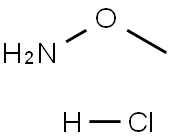
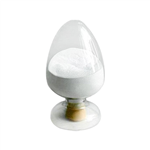
Methoxyamine hydrochloride
Methoxyamine hydrochloride (also known as O-methylhydroxylamine hydrochloride; Methoxyamine; Methoxyamine hydrochloride (OMHA), is an important medicine, pesticide intermediates. Its major applications are as follows:
- it can be used for color photography and film printing.
- it is used as a reducing agent in organic synthesis industry for preparation of oximes.
- the field of medicine: it can be used for the synthesis of second-generation cephalosporins antibiotics cefuroxime (ester), neopropene, norethindine and hydroxyurea.
- the field of pesticides: the synthesis of new efficient, low-toxicity bactericidal metominostrobin.
- It is mainly produced by sodium nitrite method in our country.
The similar compound of methoxyamine hydrochloride, the ethoxylamine hydrochloride is mainly used for the production of herbicides, oxycarbazone, diltiazem and other herbicides.
Application
- Used as a methoxyamine reagent, also used in the production of the side chain of Cefuroxime and other new drugs
- Used for pesticide synthesis.
- Use for pharmaceuticals production
- Used for the preparation of O-methyloxime together with aldehydes or ketones.
Description
Methoxamine hydrochloride, also known as methoxamine hydrochloride, O-methyl hydroxylamine hydrochloride. It is a white crystalline powder, and its fusing point is 149 ~ 152°C, soluble in water, dissolved in alcohol, insoluble in ether and toluene, etc., and the solution is in acid. Methoxamine hydrochloride is an important chemical and medicine intermediate, can be used for the development and printing of color photography and film, and is widely used in the synthesis of medicine, functional dye, low-toxin farm chemicals, and new herbicides. Methoxamine hydrochloride is mainly used in the synthesis of s-generation cephalosporin product cephalofruxin in medical, and sulfamethoxazole; alkynes promise are bright, the synthesis of hydroxyurea, etc.; Agricultural chemicals aspect is then mainly used in the kresoxim-methyl of synthesizing efficient low toxicity.
Chemical Properties
White to very faintly yellow crystalline powder
Uses
Methoxylamine hydrochloride is used as a reagent in the preparation of O-methyl oximes from aldehydes. It is orally bioavailable small molecule inhibitor with potential adjuvant activity. It is also used as internal standard for prostaglandin assays by gas chromatography-mass spectrometry.
Uses
Methoxylamine is a methoxime derivative used as internal standard for Prostaglandin assays by gas chromatography-mass spectrometry
Uses
antineoplastic, hydroxymethyltransferase inhibitor
General Description
Off-white crystals.
Air & Water Reactions
Water soluble.
Reactivity Profile
In aqueous solution, Methoxyammonium chloride behaves as an acid. Materials in this group are generally soluble in water. The resulting solutions contain moderate concentrations of hydrogen ions and have pH's of less than 7.0. They react as acids to neutralize bases. These neutralizations generate heat, but less or far less than is generated by neutralization of inorganic acids, inorganic oxoacids, and carboxylic acid. They usually do not react as either oxidizing agents or reducing agents but such behavior is not impossible. Many of these compounds catalyze organic reactions.
Fire Hazard
Flash point data for Methoxyammonium chloride are not available. Methoxyammonium chloride is probably combustible.
reaction suitability
reagent type: derivatization reagent
reaction type: Acylations
Synthesis
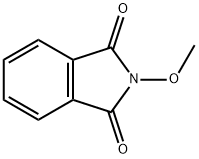
General procedure: 500 mg of hydroxyphthalimide (Aldrich) was dissolved in 5 mL of dimethylformamide (DMF) under argon protection, followed by the addition of 0.2 mL of methylene iodide (Aldrich) and 0.5 mL of 1,8-diazabicyclo[5.4.0]undec-7-ene (DBU, Aldrich) sequentially, slowly dropwise. The reaction mixture was stirred at 60 °C for 2 h and then cooled to room temperature and the reaction was quenched by addition of 2 N hydrochloric acid solution. The reaction solution was diluted with 20 mL of ethyl acetate, dried over magnesium sulfate and filtered. The filtrate was concentrated under reduced pressure and the residue was purified by silica gel column chromatography using ethyl acetate/hexane (1:5, v/v) as eluent and dried to give 407 mg of the target compound (yield: 75%). The compound was dissolved in 5 mL of dichloromethane and 0.11 mL of methylhydrazine (TCI) was slowly added at 0 °C. The reaction solution was stirred at room temperature for 2 hours and then cooled to 0°C again. The resulting solid was collected by filtration and 1 mL of 4 M dioxane hydrochloride solution (Aldrich) was added to the filtrate, filtered and dried to give 173 mg of solid product (yield: 90%). Under argon protection, 10 mg of the above solid was dissolved with 54 mg of SAC-0906 in 1 mL of pyridine (Aldrich) and stirred at 80 °C for 4 hours. After the reaction solution was cooled to room temperature, it was acidified by adding 2 N hydrochloric acid solution, extracted with 20 mL of ether, dried over magnesium sulfate and filtered. The filtrate was concentrated under reduced pressure and the residue was purified by silica gel column chromatography using ethyl acetate/hexane (1:5, v/v) as eluent to give the final methoxyamine hydrochloride SAC-1012 (48 mg, yield: 85%).1H-NMR (300 MHz, CDCl3) δ 5.91-5.76 (m, 2H), 5.34-5.32 (m, 1H) , 5.28-5.24 (m, 1H), 5.15 (m, 1H), 4.24-4.07 (m, 3H), 3.80 (s, 3H), 3.58-3.48 (m, 1H), 2.42-0.60 (m, 35H).
Purification Methods
Crystallise the hydrochloride from absolute EtOH or EtOH by addition of diethyl ether. [Kovach et al. J Am Chem Soc 107 7360 1985, Beilstein 1 IV 1252.]
References
[1] Patent: US2014/378399, 2014, A1. Location in patent: Paragraph 0096
[2] Journal of the Chemical Society. Perkin Transactions 2, 2000, # 7, p. 1435 - 1446
[3] European Journal of Medicinal Chemistry, 2014, vol. 75, p. 184 - 194