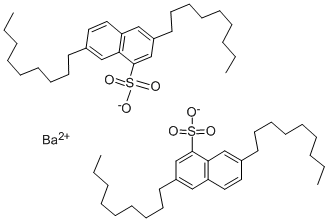
Synthesis
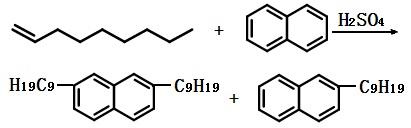
The first step, a hydrocarbonation reaction, involves distilling the composite gasoline to obtain a nonene fraction at 123-175 °C. The nonene reacts with naphthalene in the presence of concentrated sulfuric acid as a catalyst to produce dinonylnaphthalene (simultaneously, monononylnaphthalene and nonane are also produced). The reaction formula is as follows:
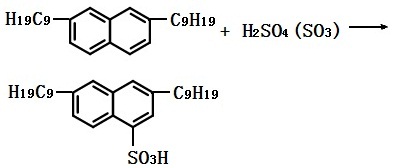
The second step, a sulfonation reaction, involves the reaction of dinonylnaphthalene with fuming sulfuric acid to produce dinonylnaphthalenesulfonic acid. The reaction formula is as follows:
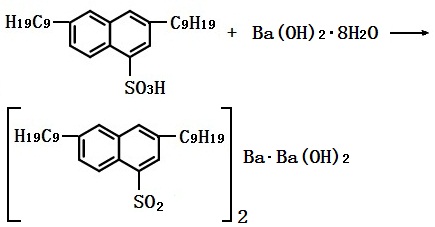
The third step, barium sulfonation, involves the reaction of dinonylnaphthalenesulfonic acid with barium hydroxide to produce barium dinonylnaphthalenesulfonate (including neutral and basic barium dinonylnaphthalenesulfonate). The reaction formula is as follows:
Chemical Properties
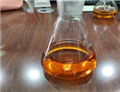
Barium dinonylnaphthalenesulfonate is a dark brown viscous liquid with a melting point of 259-260°C, a boiling point of 600-601°C, a flash point of 170°C and is practically insoluble in water. Lethal Concentration: LC50 (rat) > 21,000 mg/m3/1hr.
Uses
Barium dinonylnaphthalenesulfonate is a metal-organic reagent used primarily in chemical and experimental research to determine its micelle size in low-polarity solvents
[1]. It is also an intermediate component in the preparation of other compounds such as refrigeration oil compositions, grease compositions and high performance cooling lubricants.
References
[1] LITTLE R C. Micelle size of barium dinonylnaphthalenesulfonate in low polarity solvents by vapor pressure osmometry[J]. The Journal of Physical Chemistry , 1970. DOI:10.1021/j100703a028.