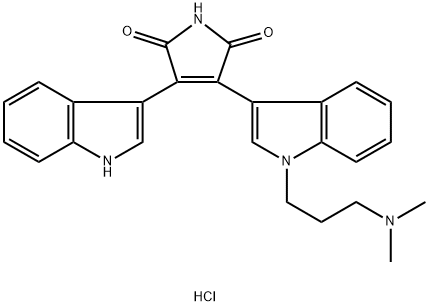
Description
Bisindolylmaleimide I (BIM I) is a highly selective, cell-permeable, and reversible PKC inhibitor (K
i = 14 nM) that is structurally similar to the poorly selective PKC inhibitor staurosporine . It acts as a competitive inhibitor for the ATP binding site of PKC and shows high selectivity for PKCα, β1, β2, γ, δ, and ε isozymes. BIM I directly inhibits glycogen synthase kinase 3 (GSK3) in primary adipocyte lysates (IC
50 = 360 nM) and in GSK3β immunoprecipitates derived from rat epididymal adipocytes (IC
50 = 170 nM). It also competitively antagonizes the serotonin (5-HT) receptor subtype 5-HT
3 with a K
i value of 61 nM.
Uses
GF 109203X hydrochloride has been used to inhibit protein kinase C in human neuroblastoma-derived kelly cells.
General Description
GF 109203X prevents collagen-triggered adenosine and three phosphate (ATP) secretion. It also inhibits collagen and α-thrombin-induced platelet aggregation. It functions as an inhibitor of glycogen synthase kinase-3 (GSK-3). GF 109203X also functions as an anti-inflammatory agent.
Biochem/physiol Actions
Inhibitor of protein kinase C; potent inhibitor of GSK-3.
in vivo
Bisindolylmaleimide I hydrochloride (0.02 mg/kg, i.p.) reduced the inceased NLRP3, P-PKCɑ, and PKCɑ levels in mechanical ventilation (MV) group[5].
Bisindolylmaleimide I hydrochloride (0-20 mg/kg, i.p.) reduces the mean frequency of Quinpirole-induced vomiting in shrews[6].
| Animal Model: | Quinpirole-treated shrews[2] |
| Dosage: | 0-20 mg/kg |
| Administration: | i.p. |
| Result: | Reduced the mean frequency of Quinpirole-induced vomiting.
Blocked Quinpirole-mediated ERK1/2 phosphorylation in shrew brainstems.
|
IC 50
Bovine brain PKC: 10 nM (IC
50); PKC-βII: 16 nM (IC
50); PKC-βI: 17 nM (IC
50); PKCα: 20 nM (IC
50); PKCγ: 20 nM (IC
50); FDGFG: 65 μM (IC
50)
References
[1] D. TOULLEC. The bisindolylmaleimide GF 109203X is a potent and selective inhibitor of protein kinase C.[J]. The Journal of Biological Chemistry, 1991, 12 1: 15771-15781. DOI:
10.1016/s0021-9258(18)98476-0[2] INGEBORG HERS Richard M D Jeremy M Tavaré. The protein kinase C inhibitors bisindolylmaleimide I (GF 109203x) and IX (Ro 31-8220) are potent inhibitors of glycogen synthase kinase-3 activity[J]. FEBS Letters, 1999, 460 3: 433-436. DOI:
10.1016/s0014-5793(99)01389-7[3] S J COULTRAP. Competitive antagonism of the mouse 5-hydroxytryptamine3 receptor by bisindolylmaleimide I, a “selective” protein kinase C inhibitor.[J]. Journal of Pharmacology and Experimental Therapeutics, 1999, 290 1: 76-82.