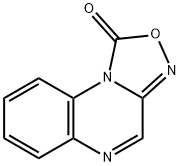
Description
ODQ (41443-28-1) is a potent and selective inhibitor of soluble guanylyl cyclase (sGC),IC50= 20 nM).1 ODQ acts via competition with NO for the heme site of sGC where it binds irreversibly.2ODQ does not inhibit NO-mediated macrophage toxicity, an activity that is unrelated to cGMP nor does it inhibit particulate GC.1ODQ is an extremely useful tool to explore the involvement of the NO-cGMP pathway in cellular signaling and physiologic processes.3-5
Chemical Properties
ODQ is off-white to yellow powder
Uses
ODQ is a selective and potent sGC (soluble guanylyl cyclase) inhibitor.
Uses
1H-[1,2,4]oxadiazolo[4,3-a]quinoxalin-1-one inhibits neurite outgrowth and causes neurite retraction in PC12 cells independently of soluble guanylyl cyclase.
Definition
ChEBI: 1H-[1,2,4]oxadiazolo[4,3-a]quinoxalin-1-one is a member of the class of oxadiazoloquinoxalines that is 1H-[1,2,4]oxadiazolo[4,3-a]quinoxaline substituted at position 1 by an oxo group. It has a role as an EC 4.6.1.2 (guanylate cyclase) inhibitor.
Biological Activity
ODQ is a potent and selective inhibitor of NO-sensitive guanylyl cyclase.
Biochem/physiol Actions
H-[1,2,4]Oxadiazolo[4,3-a]quinoxalin-1-one (ODQ) non competitively inhibits the action of nitric oxide-sensitive guanylyl cyclase and results in a supposedly irreversible oxidation of the prosthetic heme group. ODQ has been used to study the role of cyclic guanosine monophosphate (cGMP) pathway in nitric oxide (NO) signal transduction.
References
[1] J GARTHWAITE. Potent and selective inhibition of nitric oxide-sensitive guanylyl cyclase by 1H-[1,2,4]oxadiazolo[4,3-a]quinoxalin-1-one.[J]. Molecular Pharmacology, 1995, 48 2: 184-188.
[2] A SCHRAMMEL. Characterization of 1H-[1,2,4]oxadiazolo[4,3-a]quinoxalin-1-one as a heme-site inhibitor of nitric oxide-sensitive guanylyl cyclase.[J]. Molecular Pharmacology, 1996, 50 1: 1-5.
[3] A G ESTÉVEZ. Nitric oxide-dependent production of cGMP supports the survival of rat embryonic motor neurons cultured with brain-derived neurotrophic factor.[J]. Journal of Neuroscience, 1998, 18 10: 3708-3714.
[4] G VANDECASTEELE R F T Eschenhagen. Role of the NO-cGMP pathway in the muscarinic regulation of the L-type Ca2+ current in human atrial myocytes.[J]. Journal of Physiology-London, 1998, 506 ( Pt 3): 653-663. DOI:
10.1111/j.1469-7793.1998.653bv.x[5] M C MARTINS-PINGE O U L G C Araújo. Nitric oxide-dependent guanylyl cyclase participates in the glutamatergic neurotransmission within the rostral ventrolateral medulla of awake rats.[J]. Hypertension, 1999, 34 4 Pt 2: 748-751. DOI:
10.1161/01.hyp.34.4.748