Uses
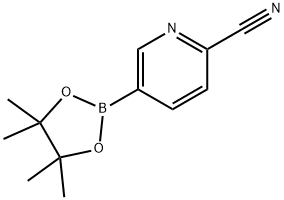
It is an important raw material and intermediate used in organic synthesis, pharmaceuticals, agrochemicals and dyestuffs. It is used in suzuki reactions.
Synthesis
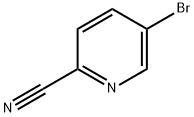
To a 250 mL round bottom flask was added 5-bromo-2-cyanopyridine (3.0 g, 16.39 mmol), bis(pinacolato)diboron (4.58 g, 18.03 mmol), potassium acetate (5.47 g, 55.74 mmol), and dimethyl sulfoxide (100 mL). After degassing for 20 min, [1,1'-bis(diphenylphosphino)ferrocene]palladium dichloride dichloromethane complex (1.39 g, 1.64 mmol) was added. The reaction mixture was stirred at 80 °C for 24 h, followed by continued stirring at room temperature for 3 days. Upon completion of the reaction, 50 mL of water was added and the product was extracted with ethyl acetate. The organic phases were combined, washed with saturated brine, dried over anhydrous sodium sulfate and concentrated under reduced pressure. The dark residue was purified by fast column chromatography (eluent: 20% acetone/hexane) to give a red solid. The solid was ground with hexane to give 1.72 g (46% yield) of the target product 5-(4,4,5,5-tetramethyl-1,3,2-dioxaborolan-2-yl)-2-cyanopyridine as a light pink solid.
References
[1] Journal of Medicinal Chemistry, 2013, vol. 56, # 13, p. 5473 - 5494
[2] Bioorganic and Medicinal Chemistry Letters, 2006, vol. 16, # 5, p. 1277 - 1281
[3] Patent: US2009/136473, 2009, A1. Location in patent: Page/Page column 36; 61
[4] Patent: US2014/364414, 2014, A1. Location in patent: Paragraph 0438; 0449-0450
[5] Patent: WO2009/74812, 2009, A1. Location in patent: Page/Page column 70