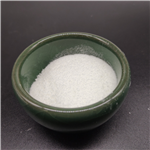
Chemical Properties
Light Yellow Powder
Uses
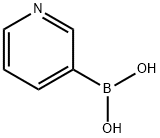
3-Pyridylboronic acid is a reagent used for• ;Phosphine-free Suzuki-Miyaura cross-coupling reactions
1 ;Regioselective Suzuki-Miyaura coupling and tandem palladium-catalyzed intramolecular aminocarbonylation and annulation
2 ;N-arylation using copper acetylacetonate catalyst
3 ;Copper-mediated cyanation and regioselective cyanation of electron-rich benzenes
4 Reagent use in Preparation of • ;New linear poly(phenylpyridyl) chains by Suzuki coupling
5 ;Oligopyridyl foldamers as mimics of a-helix twist
6 ;Many highly significant therapeutic enzymatic and kinase inhibitors and r
Uses
Boronic acid derivatives and their binding affinities with diols.
Synthesis Reference(s)
The Journal of Organic Chemistry, 64, p. 3846, 1999
DOI: 10.1021/jo9819279Tetrahedron Letters, 43, p. 4285, 2002
Synthesis
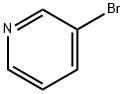
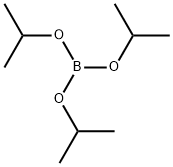
The general procedure for the synthesis of pyridine-3-boronic acid from 3-bromopyridine and triisopropyl borate was as follows: first, pyridine-3-boronic acid (1-6) was prepared by subsequent hydrolysis via an appropriate esterification reaction according to the method of Cai et al. (Tetrahedron Lett. 43: 4285-4287, 2002). This was done as follows: 85 mL of toluene was added to a 500 mL three-necked flask, cooled to below -60°C, and then 1.6 M of n-BuLi hexane solution (48.6 mL, 77.8 mmol) was added dropwise over 10 min. After the internal temperature reached -60°C, a toluene solution (30 mL) of 3-bromopyridine (6.8 mL, 70.7 mmol) was slowly added dropwise to keep the internal temperature below -50°C. At this point, a brownish-black solid precipitated, and the resulting slurry was stirred for 20 min. Next, 30 mL of THF was added dropwise to keep the internal temperature below -50°C and stirring was continued for 15 min. Subsequently, triisopropyl borate (19.6 mL, 84.9 mmol) was added all at once via syringe. The solution was slowly heated to -15°C, and the reaction was quenched with 2.7 N aqueous HCl (70.0 mL) and transferred to a partition funnel. The aqueous layer was separated and the organic layer was washed with 10 mL of water. The combined aqueous layers were neutralized to pH 7 with 10 N NaOH aqueous solution and extracted with THF (200 mL x 1, 125 mL x 2). The organic phases were combined and concentrated under reduced pressure. The residue was dissolved in THF/CH3OH (1:1, 140 mL), filtered and diluted with CH3CN to 300 mL.The solvent was converted to CH3CN by distillation and concentrated to 100 mL.The solids were collected by filtration to afford pyridine-3-boronic acid 1 (6.4 g, 73% yield) as an off-white solid. The product was confirmed by 1H NMR (CD3OD): δ 8.64 (br s, 1H), 8.50 (m, 1H), 8.38 (br s, 1H), 7.65 (br s, 1H). The product can be used directly in Suzuki cross-coupling reaction.
References
[1] Patent: WO2005/66162, 2005, A1. Location in patent: Page/Page column 92
[2] Organic Syntheses, 2005, vol. 81, p. 89 - 97