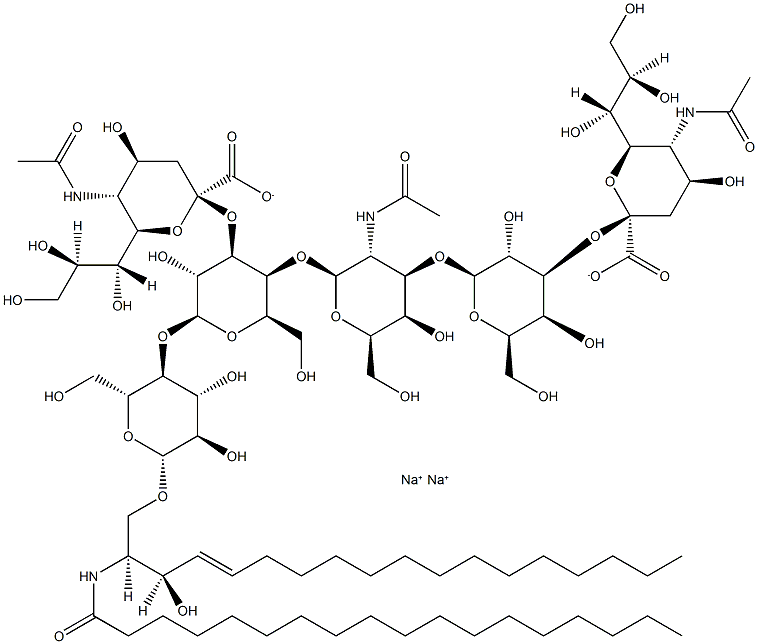
Description
Ganglioside G
D1a is a sialic acid-containing glycosphingolipid found in brain, erythrocytes, bone marrow, testis, spleen, and liver. It can be shed from the surface of tumor cells into the microenvironment where it influences tumor-host cell interactions to promote tumor cell proliferation, invasion, and metastasis. Ganglioside G
D1a (20 μM) also increases endothelial cell proliferation. Furthermore, ganglioside G
D1a has been shown to act as a functional coreceptor for toll-like receptor 2 (TLR2), enabling the recruitment of TLR2 to lipid rafts when bound by a bacterial toxin. Ganglioside G
D1a mixture contains ganglioside G
D1a molecular species with C18:1 and C20:1 sphingoid backbones.
Chemical Properties
White powder
Uses
Ganglioside GD1a Disodium Salt is an agent with a stimulatory effect on phagocytosis and phagosome-lysosome.
General Description
Ganglioside GD1a is an anionic brain ganglioside. It is localized in the inner and outer membrane of nuclear envelope of the neuronal cells. GD1a contains a neutral tetrasaccharide core, with one or two sialic acid on the internal galactose. It also has an additional sialic acid on the non-reducing terminal of galactose.
References
[1] PURNA MUKHERJEE. Thematic review series: sphingolipids. Ganglioside GM3 suppresses the proangiogenic effects of vascular endothelial growth factor and ganglioside GD1a.[J]. Journal of Lipid Research, 2008: 929-938. DOI:
10.1194/jlr.r800006-jlr200[2] SHUANG LIANG. Ganglioside GD1a is an essential coreceptor for Toll-like receptor 2 signaling in response to the B subunit of type IIb enterotoxin.[J]. The Journal of Biological Chemistry, 2007, 282 10: 7532-7542. DOI:
10.1074/jbc.m611722200[3] M IWAMORI. Gangliosides of various rat tissues: distribution of ganglio-N-tetraose-containing gangliosides and tissue-characteristic composition of gangliosides.[J]. Journal of biochemistry, 1984, 95 3: 761-770. DOI:
10.1093/oxfordjournals.jbchem.a134667[4] De Souza, F.I., Zumiotti, A.V., and Da Silva, C.F. Neuregulins 1-α and 1-β on the regeneration the peripheral nerves[J]. Acta Ortop Bras.
[5] WALKLEY S U. Secondary accumulation of gangliosides in lysosomal storage disorders[J]. Seminars in cell & developmental biology, 2004, 15 4: Pages 433-444. DOI:
10.1016/j.semcdb.2004.03.002