Chemical Properties
Clear Colourless Oil
Uses
It is used in the synthesis of For-Met-Leu-Phe-OMe (fMLF-OMe) analogues based on Met residue replacement by 4-amino-proline scaffold.
Uses
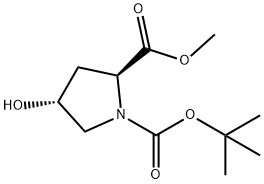
(2S,4R)-4-Hydroxypyrrolidine-1,2-dicarboxylic Acid 1-tert-Butyl Ester 2-Methyl Ester
roline scaffold.
Uses
A potential iNOS inhibitor.
reaction suitability
reaction type: Boc solid-phase peptide synthesis
Synthesis
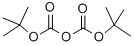
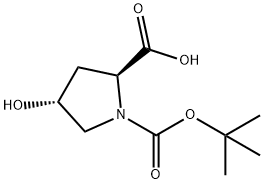
The general procedure for the synthesis of N-Boc-trans-4-hydroxy-L-proline methyl ester from di-tert-butyl dicarbonate and trans-4-hydroxy-L-proline methyl ester hydrochloride was as follows: the trans-4-hydroxy-L-proline methyl ester hydrochloride (14.5 g, 0.1 mol) obtained in step I was suspended in CH2Cl2 (400 mL), cooled to 0 °C, and with stirring, sequentially Et3N (28 mL, 0.2 mol), DMAP (0.61 g, 5 mmol) and Boc anhydride (27.5 mL, 0.12 mol) were added. The reaction mixture was gradually warmed to room temperature and stirring was continued for 2 hours. After completion of the reaction, the solvent was removed by concentration under reduced pressure, ether was added to the residual solid, the solid was collected by filtration and washed well with ether. The filtrates were combined and concentrated under reduced pressure. The residue was dissolved in CH2Cl2, washed with saturated aqueous NaHCO3 and saturated aqueous NaCl in turn, and the organic phase was dried with anhydrous Na2SO4. The solvent was evaporated under reduced pressure to give a light yellow oil, which was solidified by high vacuum treatment. The resulting solid was ground several times with hexane and dried in high vacuum to obtain 1-tert-butyl-2-methyl (2S,4R)-4-hydroxypyrrolidine-1,2-dicarboxylate as a white solid (24.5 g, 100% yield). The product characterization data were as follows:(M+1) 245; 1H NMR (CDCl3, 300MHz) δ 4.54-4.37 (m, 2H), 3.75 (s, 3H), 3.70-3.40 (m, 2H), 2.48-2.21 (m, 2H), 2.13-2.0 (m, 1H), 1.46 (s, 3H), 1.41 (s, 6H).
IC 50
Non-cleavable Linker
References
[1] Bioorganic and Medicinal Chemistry Letters, 2004, vol. 14, # 22, p. 5699 - 5702
[2] Patent: WO2007/113634, 2007, A1. Location in patent: Page/Page column 60-61
[3] Tetrahedron Asymmetry, 2009, vol. 20, # 12, p. 1433 - 1436
[4] Journal of Chemical Research, 2009, # 11, p. 668 - 670
[5] Tetrahedron Letters, 2012, vol. 53, # 30, p. 3847 - 3849