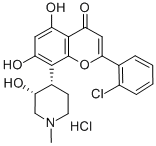
Description
Flavopiridol is an orally bioavailable inhibitor of cyclin dependent kinases (IC
50s = ~100, ~100, ~100, and 300 nM for Cdk1, Cdk2, Cdk4, and Cdk7, respectively). It also inhibits TEFb, a complex composed of Cdk9 and cyclin T1, with a K
i value of 3 nM. Flavopiridol inhibits transcription of a CMV promoter in HeLa nuclear extract (IC
50 = 34 nM), Tat-stimulated transcription of an HIV-1 promotor (IC
50 = 7 nM), and HIV-1 replication in HEK239T cells (IC
50 = <10 nM).
In vivo, flavopiridol (5 mg/kg, i.p.) induces apoptosis and cyclin D1 depletion and delays tumor growth in an HN-12 head and neck carcinoma mouse xenograft model. It also suppresses synovial hyperplasia and joint destruction in a mouse model of collagen-induced arthritis.
Chemical Properties
Yellow Powder
Uses
Flavopiridol hydrochloride hydrate has been used:
- as a cyclin-dependent kinase 9 (CDK9) inhibitor to study its effects on histone H3 methylation at lysine 36 (H3K36) and deactivation of transcription in porcine fetal fibroblasts
- as an RNA polymerase inhibitor to study its effects on hepatic cells
- as RNA transcription inhibitor to study its effects on euchromatin coarsening in zebrafish embryo
Uses
An inhibitor of cyclin-dependent kinases; the (-)-cis form induces apoptosis in certain tumor cells.
Definition
ChEBI: A hydrochloride salt resulting from the formal reaction of equimolar amounts of alvocidib and hydrogen chloride. A cyclin-dependent kinase 9 (CDK9) inhibitor, it has been studied for the treatment of acute myeloid leukaemia, arthritis and atherosclerotic p
aque formation.
Biochem/physiol Actions
Flavopiridolis a semi-synthetic flavone obtained from Dysoxylum binectariferum that acts as an anti-tumor agent against several cancers. It also shows anti-cancer properties due to which it has been studied in the treatment of acute myeloid leukemia (AML).
References
[1] G KAUR. Growth inhibition with reversible cell cycle arrest of carcinoma cells by flavone L86-8275.[J]. JNCI Journal of the National Cancer Institute, 1992, 84 22: 1736-1740. DOI:
10.1093/jnci/84.22.1736[2] L. CARTEE. Synergistic induction of apoptosis in human myeloid leukemia cells by phorbol 12-myristate 13-acetate and flavopiridol proceeds via activation of both the intrinsic and tumor necrosis factor-mediated extrinsic cell death pathways.[J]. Molecular Pharmacology, 2002, 135 1: 1313-1321. DOI:
10.1124/mol.61.6.1313[3] GRAZIA AMBROSINI. The cyclin-dependent kinase inhibitor flavopiridol potentiates the effects of topoisomerase I poisons by suppressing Rad51 expression in a p53-dependent manner.[J]. Cancer research, 2008: 2312-2320. DOI:
10.1158/0008-5472.can-07-2395[4] SCHANG L M. Effects of pharmacological cyclin-dependent kinase inhibitors on viral transcription and replication[J]. Biochimica et biophysica acta. Proteins and proteomics, 2004, 1697 1: Pages 197-209. DOI:
10.1016/j.bbapap.2003.11.024