Reactions
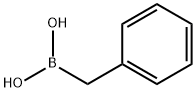
By generating and immediately capturing the Benzylboronic acid under mild photochemical conditions, a series of structurally diverse and stable Benzylboronic acid (and esters) have been developed. These boronic acid esters can then serve as general building blocks for constructing complex molecular structures through various well-established boron chemical transformations, such as oxidation, Chan–Lam coupling, Matteson homologation, deboronization/deuteration, etc
[2].
Uses
As a typical saturated boronic acid distinguished by a C(sp³)–B bond, benzylboronic acid has a wide range of applications as a synthetic intermediate. Benzylboronic acid serves as an organoboron intermediate for selective coupling reactions (e.g., Suzuki coupling). It also serves as a versatile synthetic building block for constructing C(sp³)–C and C(sp³)–X(heteroatom) bonds
[2].
Synthesis
Benzylboronic acid is synthesized through a novel electrochemical reductive coupling reaction that utilizes benzylic halides and borating agents, such as trialkylborates or pinacolborane, as primary reagents. The process is conducted within a single-compartment electrochemical cell featuring a sacrificial magnesium anode and employing either DMF or THF as the solvent
[1].

References
[1] Pintaric, C., Laza, C., Olivero, S., Dunach, E. (2005). Electrosynthesis of Benzylboronic Acids and Esters. ChemInform, 36 6.
https://doi.org/10.1002/chin.200506158[2] Álvaro Valdés-Maqueda, López, L., Plaza, M., Valdés, C. (2023). Synthesis of substituted benzylboronates by light promoted homologation of boronic acids with N-sulfonylhydrazones. 35 1, 0.
https://doi.org/10.26434/chemrxiv-2023-qjw9z