Uses
anticonvulsant, antimigraine, GABA-A agonist, AMP/kinate glutamate receptor antagonist, carbonic anhydrase inhibitor
Uses
Used as an anticonvulsant
Uses
Used for the treatment and control of partial seizures and severe tonic-clonic (grand mal) seizures and also for the prevention of migraine headaches. In children it is also used for treatment of Lennox-Gastaut syndrome. Qsymia? is indicated for the treat
Definition
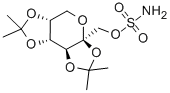
ChEBI: A hexose derivative that is 2,3:4,5-di-O-isopropylidene-beta-D-fructopyranose in which the hydroxy group has been converted to the corresponding sulfamate ester. It blocks voltage-dependent sodium channe
s and is used as an antiepileptic and for the prevention of migraine.
Biological Activity
Anticonvulsant. Antagonizes GluR5 kainate receptors (IC 50 = 0.46 μ M), acts as a positive allosteric modulator of GABA A receptor-mediated currents, inhibits Na v channels (IC 50 = 48.9 μ M) and inhibits L-type Ca 2+ channels. Also inhibits carbonic anhydrase (CA) (K i values are 0.1 and 0.2 μ M at rat CA II and CA IV respectively), which lowers intracellular neuronal pH.
Description
Topiramate, a novel sulfamate-substituted D-fructose derivative, was launched
in the United Kingdom as an adjunct therapy for use in partial seizures with or
without secondary generalized seizures in adult patients inadequately controlled on
conventional antiepileptics. Topiramate is structurally distinct from other available
antiepileptics and functions through a unique combination of several mechanisms. It
appears to act by blocking voltage-sensitive sodium channels to raise the action
potential threshold and block the spread of seizure, enhancing GABA activity at
postsynaptic GABA receptors and reducing glutamate activity at postsynaptic AMPAtype
receptors, and is also a carbonic anhydrase inhibitor. Topiramate is orally active
with rapid absorption, high bioavailability, and long duration of action. Excellent
efficacy has been reported as an add-on therapy in epilepsy and it is also being
evaluated as a monotherapy.
Chemical Properties
White-to-Off-White Crystalline Powder
Originator
Johnson & Johnson (U.S.A.)
History
The development of topiramate originated from exploratory research conducted by Janssen Pharmaceuticals, a subsidiary of Johnson & Johnson, in the late 1970s. Initially, the research focused on developing a fructose-1,6-bisphosphatase inhibitor for the treatment of diabetes. However, researchers unexpectedly discovered the compound's anticonvulsant properties during screening. This discovery led to a fundamental shift in research direction. Through the systematic work of a team of chemists (including principal inventors Harvey J. Klimish and Craig A. Marianov), the molecular structure of topiramate was eventually determined through continuous optimization of the compound's structure. Subsequent research gradually elucidated its unique multiple mechanisms of action, including blocking voltage-gated sodium channels, enhancing GABA-A receptor activity, and antagonizing AMPA/algal taurine receptors. After rigorous clinical evaluation, the drug was first approved by the U.S. Food and Drug Administration (FDA) in 1996 as an adjunct treatment for epilepsy. Subsequently, its indications expanded to include migraine prevention (approved in 2004) and its use in combination with other drugs for weight management.
Manufacturing Process
To a cold solution (-4°C) of 2,3:4,5-di-O-isopropylidene-β-fructopyranose (75
g, 0.29 mol) in DMF (725 ml) was added 50% oily sodium hydride (16.34 g,0.34 mol). After stirring for 90 min, sulfamoyl chloride (54.9 g, 0.48 mol) was
added and the stirring continued for an additional 3.5 h at that temperature.
The reaction mixture was poured into cold water and extracted with toluene.
The organic layer was dried (Na2SO4) and the solvents removed under
vacuum to give a syrup which crystallized immediately. Recrystallization from
ethylacetate/hexane gave pure 2,3:4,5-bis-O-(1-methylethylidene)-β-D_x0002_fructopyranose sulfamate, melting point 125°-126°C.
Therapeutic Function
Anticonvulsant
Biological Functions
Topiramate is most useful in patients with generalized
tonic–clonic seizures and those with partial complex
seizures. Topiramate causes a higher incidence of CNSrelated
side effects (primarily cognitive slowing and
confusion) than other AEDs. It does not appear to
cause a significant incidence of rashes or other hypersensitivity
reactions; however, a significantly higher incidence
of kidney stones has been observed in persons
receiving topiramate than in a similar untreated population.
General Description
TPM is a sulphamate-substituted monosaccharide, a derivativeof the naturally occurring sugar D-fructose thatexhibits broad and potent AED actions at both glutamateand GABA receptors.19 It has good oral bioavailability of85% to 95%, most likely resulting from its structural similarityto D-glucose. Thus, it may be actively transportedinto the brain by the D-glucose transporter. (Recall thatD-fructose and D-glucose have identical stereochemistry atmany of their chiral centers.) Only about 20% of the drugis eliminated by hepatic metabolism (CYP2C19), the remainingdrug is excreted unchanged by the kidneys.57 Thesulphamate ester is hydrolyzed by sulfatases to the correspondingprimary alcohol, which is further oxidized to thecorresponding carboxylic acid. Even though there are noreports of significant interactions between TPM and otherAEDs, TPM is said to have a weak carbonic anhydrase inhibitoryactivity because of the presence of the sulphamatemoiety. Thus, concomitant use of TPM with other carbonicanhydrase inhibitors should be avoided.57 The exact mechanismof actions are still unknown, but TPM appears toblock glutamate release, antagonize glutamate kainicacid/AMPA receptors, and increase GABAergic transmissionby binding to a site distinct from BZDs or barbiturateson the GABAA receptor complex.
Biochem/physiol Actions
Kainate GluR5 receptor antagonist; anticonvulsant.
Mechanism of action
The mechanism of action for topiramate is unknown, but several actions are thought to contribute to its AED activity. It
blocks repetitive firing by acting on sodium channels, may enhance GABAA-mediated chloride flux, and appears to be an
antagonist at the AMPA and KA receptors, thus blocking the effect of glutamate. In addition, recent evidence
suggests inhibition of L-type calcium currents.
Clinical Use
Topiramate is a sulfamate-substituted monosaccharide derived from fructose with a broad spectrum of AED activity. It is
approved for monotherapy or as an adjunct drug for partial or primary generalized tonic-clonic seizures in patients older than
10 years, as adjunct therapy in children aged from 2 to 10 years with partial-onset seizures, and in persons older than 2 years
with Lennox-Gastaut syndrome. Topiramate also is approved for the prophylaxis of migraine headaches.
Side effects
Common CNS side effects associated with topiramate therapy include drowsiness, dizziness, impaired concentration and
memory, speech and language difficulties, and confusion. These effects develop during the first weeks of therapy and may
decline over time. Acute closed-angle glaucoma caused by topiramate requires immediate evaluation. Only rare hepatic or
bone marrow effects have been noted thus far; however, an increased incidence of renal stones is troublesome and probably
related to the drug's activity as a carbonic anhydrase inhibitor, reducing citrate excretion and increasing urinary pH. Use of
additional carbonic anhydrase inhibitors, a ketogenic diet, or a family history of nephrolithiasis may be considered as
contraindications for using topiramate.
Topiramate is not devoid of potential interaction properties: It induces CYP3A4 and inhibits CYP2C19, thus significantly increasing plasma phenytoin levels. Topiramate also may decrease the effectiveness of oral contraceptives.
Synthesis
Ziconitide is the synthetic form of
the conotoxin ω-conopeptide MVIIA .
Veterinary Drugs and Treatments
Topiramate may be useful for treating seizures in dogs, particularly
partial seizure activity. It may also be of benefit in treating cats, but
little information is available.
in vitro
in principal neurons of the rat basolateral amygdala, low concentrations of topiramate selectively inhibited pharmacologically isolated excitatory synaptic currents mediated by kainate receptors with the glur5 subunit with an ic50 value of 0.5 μm. topiramate also partially depressed predominantly ampa-receptor-mediated epscs with lower efficacy [1]. in dissociated neocortical slices, low concentrations of tpm (25–30 μm) slightly inhibited the persistent fraction of na+ current and reduced the na+-dependent long-lasting action potential shoulders evoked in layer v pyramidal neurons after ca2+ and k+ current blockade. tpm (100 μm) had no effects on the voltage dependence of activation but induced a leftward shift of the steady-state inaf inactivation curve [3].
in vivo
tpm treatment significantly improved the 24-h neurological deficit scores (high dose, 1.17 ± 0.41; low dose, 1.75 ± 0.5; p < 0.05 for both doses). the percentage of infarct volume (low dose, 22.9 ± 8.9%, p = 0.002; high dose 7.6 ± 3.4%, p < 0.001) reduced when compared with the controls (infarct size, 54.2 ± 9.0%; neurobehavior score, 2. 67 ± 0.52). higher dose of tpm induced more neuroprotection than that of lower dose (p < 0.05). in a rat model of focal ischemia, treatment with tpm 2 h after mca embolization resulted in neuroprotective effect in a dose- and use-dependent manner [2]. topiramate (25-100 mg/kg, i.p.) dose-dependently elevated the threshold for clonic seizures induced by infusion of a selective agonist of glur5 kainate receptors atpa [4]. topiramate (i.p) effectively suppressed acute seizures induced by perinatal hypoxia in a dose-dependent manner with an ed50 of 2.1 mg/kg [5]. topiramate (20 and 40 mg/kg i.p.) dose-dependently inhibited both tonic and absence-like seizures. in dba/2 mice, topiramate inhibited sound-induced seizures with ed50 of 8.6 mg/kg (p.o) [6].
Drug interactions
Potentially hazardous interactions with other drugs
Antidepressants: antagonism of anticonvulsant
effect; avoid with St John’s wort.
Antiepileptics: concentration reduced by
fosphenytoin, phenytoin, carbamazepine and possibly
phenobarbital; increases fosphenytoin and phenytoin
concentration; reduces concentration of perampanel;
hyperammonaemia and CNS toxicity reported with
valproate.
Antimalarials: mefloquine antagonises
anticonvulsant effect.
Antipsychotics: anticonvulsant effect antagonised.
Oestrogens and progestogens: reduced contraceptive
effect.
Orlistat: possibly increased risk of convulsions.
Ulipristal: reduced contraceptive effect - avoid.
Metabolism
Topiramate is not extensively metabolised (~20
%) in
healthy volunteers. It is metabolised up to 50
% in patients
receiving enzyme-inducing drugs. Six metabolites formed
through hydroxylation, hydrolysis and glucuronidation
have been identified but have little activity. It is eliminated
chiefly in urine, as unchanged drug and metabolites.
References
[1] gryder d s, rogawski m a. selective antagonism of glur5 kainate-receptor-mediated synaptic currents by topiramate in rat basolateral amygdala neurons[j]. the journal of neuroscience, 2003, 23(18): 7069-7074.
[2] yang y, shuaib a, li q, et al. neuroprotection by delayed administration of topiramate in a rat model of middle cerebral artery embolization[j]. brain research, 1998, 804(2): 169-176.
[3] taverna s, sancini g, mantegazza m, et al. inhibition of transient and persistent na+ current fractions by the new anticonvulsant topiramate[j]. journal of pharmacology and experimental therapeutics, 1999, 288(3): 960-968.
[4] kaminski r m, banerjee m, rogawski m a. topiramate selectively protects against seizures induced by atpa, a glur5 kainate receptor agonist[j]. neuropharmacology, 2004, 46(8): 1097-1104.
[5] koh s, jensen f e. topiramate blocks perinatal hypoxia‐induced seizures in rat pups[j]. annals of neurology, 2001, 50(3): 366-372.
[6] nakamura j, tamura s, kanda t, et al. inhibition by topiramate of seizures in spontaneously epileptic rats and dba/2 mice[j]. european journal of pharmacology, 1994, 254(1-2): 83-89.