Potential Exposure
Tetrazine miticide used on a wide variety of crops�fruit, cereals, rangeland, ornamentals, etc. An EPA Restricted Use Pesticide (RUP).
First aid
If this chemical gets into the eyes, remove any contact lenses at once and irrigate immediately for at least 15 minutes, occasionally lifting upper and lower lids. Seek medical attention immediately. If this chemical contacts the skin, remove contaminated clothing and wash immediately with soap and water. Seek medical attention immediately. If this chemical has been inhaled, remove from exposure, begin rescue breathing (using universal precautions) if breathing has stopped, and CPR if heart action has stopped. Transfer promptly to a medical facility. When this chemical has been swallowed, get medical attention. Give large quantities of water and induce vomiting. Do not make an unconscious person vomit
Shipping
UN3077 Environmentally hazardous substances, solid, n.o.s., Hazard class: 9; Labels: 9-Miscellaneous hazardous material, Technical Name Required
Incompatibilities
Oxidizers (chlorates, nitrates, peroxides, permanganates, perchlorates, chlorine, bromine, fluorine, etc.); strong acids. Decomposes above 185°C
Description
Clofentazine is a selective insecticide used to control mites. It has a low aqueous solubility and is not volatile. It is moderately persistent in soil systems but tends not to be in aquatic systems. Based on its physico-chemical properties it is not expected to leach to groundwater. Clofentazine is highly toxic to birds and fish and moderately toxic to aquatic invertebrates, honeybees and earthworms. It has a low mammalian toxicity.
Chemical Properties
Magenta crystalline solid
Waste Disposal
Do not discharge into drains or sewers. Consult with environmental regulatory agencies for guidance on acceptable disposal practices. In accordance with 40CFR165, follow recommendations for the disposal of pesticides and pesticide containers. Containers must be disposed of properly by following package label directions or by contacting your local or federal environmental control agency, or by contacting your regional EPA office.
Uses
Clofentezine is a mite growth regular and an tetrazine based acaricide. Clofentezine is used in agriculture for the protection of ornamentals, food and non-food crops in the field.
Definition
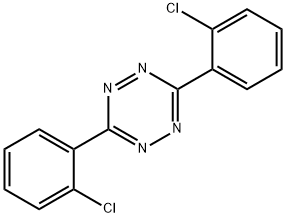
ChEBI: A tetrazine that is 1,2,4,5-tetrazine in which both of the hydrogens have been replaced by o-chlorophenyl groups.
Production Methods
Clofentezine is produced commercially through a multi-step chemical synthesis involving chlorination, oxidation, and condensation reactions. The process typically begins with the chlorination of an aromatic precursor to introduce chlorine atoms at specific positions. This is followed by an oxidation step to prepare the intermediate compounds necessary for the final condensation reaction. The condensation step involves combining these intermediates under controlled conditions to form clofentezine.
Agricultural Uses
Miticide: A U.S. EPA restricted Use Pesticide (RUP). Used
on a wide variety of crops – fruit, cereals, rangeland, ornamentals, etc
Trade name
APOLLO®; OVATION®
Mechanism of action
Specific with contact action and long residual activity. Mite growth inhibitor affecting CHS1.
Pesticide Type
Acaricide; Insecticide