General Description
It is a white, crystalline, and odorless powder with a slightly bitter taste. It is insoluble in water and chloroform, soluble in acetone and sodium hydroxide solution, slightly soluble in ethanol, but is readily hydrolyzed
Reactivity Profile
Strong reducing agents will produce toxic gases ammonia and hydrogen sulfide.
Air & Water Reactions
Insoluble in water.
Fire Hazard
Flash point data for this chemical are not available but HYDROCHLOROTHIAZIDE is probably combustible.
Originator
Hydrodiuril,MSD,US,1959
Definition
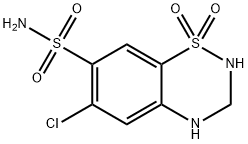
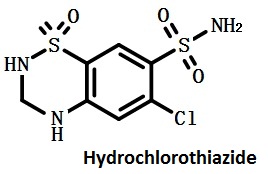
ChEBI: Hydrochlorothiazide is a benzothiadiazine that is 3,4-dihydro-2H-1,2,4-benzothiadiazine 1,1-dioxide substituted by a chloro group at position 6 and a sulfonamide at 7. It is diuretic used for the treatment of hypertension and congestive heart failure. It has a role as a xenobiotic, an environmental contaminant, a diuretic and an antihypertensive agent. It is a benzothiadiazine, a sulfonamide and an organochlorine compound.
Manufacturing Process
As described in US Patent 3,163,645, a mixture of 2.9 grams of 5-chloro-2,4-
disulfamyl aniline in 15 ml of anhydrous diethyleneglycol dimethyl ether, 0.5
ml of an ethyl acetate solution containing 109.5 grams of hydrogen chloride
per 1,000 ml and 0.33 grams (0.011 mol) of paraformaldehyde is heated to
80° to 90°C and maintained at that temperature for 1 hour. The resulting
mixture is cooled to room temperature and concentrated to one-third of its volume under reduced pressure, diluted with water, then allowed to
crystallize. The product is filtered off and recrystallized from water, to yield
the desired 6-chloro-7-sulfamyl-3,4-dihydro-2H-[1,2,4]-benzothiadiazine-1,1-
dioxide, MP 266° to 268°C, yield 1.4 grams. By replacing paraformaldehyde
by 0.84 gram of 1,1 -dimethoxymethane and proceeding as above, the same
compound is obtained.
As described in US Patent 3,025,292, the desired product may be made by
hydrogenation of chlorothiazide. Three grams of 6-chloro-7-sulfamyl-1,2,4-
benzothiadiazine-1,1-dioxide (chlorothiazide) is suspended in 100 ml of
methanol. Then 1.0 gram of a 5% ruthenium on charcoal catalyst is added,
and the mixture is reduced at room temperature and at an initial hydrogen
pressure of 39 psig. The theoretical amount of hydrogen to form the 3,4-
dihydro derivative is absorbed after a period of about 10 hours.
The reduction mixture then is heated to boiling and filtered hot to remove the
catalyst. The catalyst is washed with a little methanol and the combined
filtrate is concentrated to a volume of about 25 ml by evaporation on a steam
bath. Upon cooling to room temperature, white crystals separate which are
filtered, washed with water, and dried in vacuo at room temperature over
phosphorus pentoxide overnight. The weight of 6-chloro-7-sulfamyl 3,4-
dihydro-1,2,4-benzothiadiazine-1,1-dioxide obtained is 1.26 grams; MP 268.5°
to 270°C. Dilution of the above filtrate with water to a volume of about 125
ml gives a second crop of product having the same melting point and
weighing 1.22 grams, giving a combined yield of 83%. When the product is
mixed with an authentic sample of 6-chloro-7-sulfamyl-3,4-dihydro-1,2,4-
benzothiadiazine-1,1-dioxide, prepared by another method, the melting point
is not depressed.
Brand name
Esidrix (Novartis); Hydro-D (Halsey); Hydrodiuril
(Merck); Microzide (Watson); Oretic (Abbott); Zide
(Solvay Pharmaceuticals).
Therapeutic Function
Diuretic
Biological Activity
Carbonic anhydrase inhibitor
Synthesis
Hydrochlorothiazide, 1,1-dioxide 6-chloro-3,4-dihydro-2H-1,2,4-
benzothiadiazin-7-sulfonamide (21.3.4), is synthesized either by cyclization of 4,6-sulfonamido-
3-chloroaniline (21.3.2) using paraformaldehyde, during which simultaneous
reduction of the double bond occurs at position C3¨CC4, or the drug is synthesized by reduction
of the same double bond in chlorothiazide (21.3.3) by formaldehyde. This small change
in structure increases activity of the drug in comparison with chlorothiazide, and increases
its absorbability when used orally.

Veterinary Drugs and Treatments
In veterinary medicine, furosemide has largely supplanted the use
of thiazides as a general diuretic (edema treatment). Thiazides are
still used for the treatment of systemic hypertension,
nephrogenic
diabetes insipidus, and to help prevent the recurrence of calcium
oxalate uroliths in dogs.
References
[1] Patent: WO2009/150497, 2009, A1. Location in patent: Page/Page column 9
[2] Pharmazie, 1987, vol. 42, # 3, p. 162 - 164
[3] Journal of the American Chemical Society, 1960, vol. 82, p. 1161 - 1166
[4] Journal of Organic Chemistry, 1960, vol. 25, p. 970 - 981
[5] Journal of the American Chemical Society, 1960, vol. 82, p. 1132 - 1135