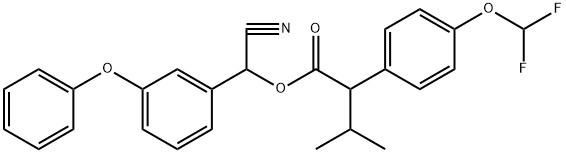
Description
Flucythrinate is a pyrethroid insecticide once used to control a wide range of pests on various fruit and vegetables but now largely obsolete. It has a low aqueous solubility and a low volatility. It is moderately persistent in soils but less so in water. Based on its physico-chemical properties it is not expected to leach to groundwater. Toxicity data for biodiversity is sparse but high for mammals, bees, fish and aquatic invertebrates. Flucythrinate is high toxic to humans via the oral route and it is considered to be a neurotoxicant.
Uses
Flucythrinate controls a wide range of insects on cotton, fruit trees,
vines, citrus, bananas, pineapples, olives, coffee, cocoa, hops, vegetables,
soyabeans, cereals, alfalfa, sugar beet, sunflowers and tobacco.
Uses
Nonsystemic insecticide.
Production Methods
Flucythrinate is commercially produced through esterification of two key intermediates: (+)-alpha-cyano-m-phenoxybenzyl alcohol and (+)-alpha-isopropyl-4-difluoromethoxyphenylacetyl chloride. The process begins with the synthesis of the acid chloride from the corresponding carboxylic acid using reagents like thionyl chloride in an organic solvent such as dichloromethane. This acid chloride is then reacted with the cyano-phenoxybenzyl alcohol in the presence of a base like pyridine to form the ester linkage, yielding flucythrinate. The reaction is conducted under controlled temperature and anhydrous conditions to ensure high yield and purity.
General Description
Flucythrinate belongs to the class of synthetic pyrethroids, primarily used to control Heliothis spp. in cotton and other insect pests in agricultural crops.
Agricultural Uses
Insecticide, Acaricide: Not approved for use in EU countries. Not currently registered in the U.S. Flucythrinate is a synthetic pyrethroid used to control pests in apples, cabbage, head lettuce, pears, corn and cotton, but it was used primarily on cotton.
Trade name
AASTAR®[C]; CYBOLT®; CYTHRIN®;
FUCHING JUJR®; GUARDIAN®[C]; PAYOFF®[C];
STOCK GUARD®; TOMAHAWK®
Mechanism of action
Non-systemic with contact and stomach action. Sodium channel modulator.
Pharmacology
Flucythrinate
is the (S)-2-(4-difluoromethoxyphenyl)-3-methylbutyrate
analog of fenvalerate, partially resolved. Its insecticide
action is approximately two times higher compared
with fenvalerate (138,142).
Environmental Fate
Surface Water. The half-life of ?ucythrinate in an estuarine environment is 34 days (Schimmel et al., 1983).
Chemical/Physical. Hydrolyzes in aqueous solutions forming acetic acid and other compounds.
Metabolic pathway
Flucythrinate is an analogue of fenvalerate and would be expected to
have a similar fate.
Degradation
Flucythrinate is a stable compound but it is readily hydrolysed at alkaline
pH to afford 2-(4-difluoromethoxyphenyl)-3-methylbutyric acid (2),
3PBAl(3) and cyanide ion. Its DT50 values at 27 °C are 52 days (pH 5) and
6.3 days (pH 9). It undergoes aqueous and soil surface photolysis with
DT50 values of 1-4 days and <2 days, respectively. The products formed
under aqueous conditions were 2 and 3. Compound 3 was oxidised to
3PBA (4) and reduced to 3PBAlc (5). The α-carbamoyl (amide) derivative
(6) of 3PBAlc was also detected. On soil surfaces, products were similar
with the exceptions that 3PBA was not formed and the α-amide (7) and
a-carboxy derivative (8) were formed. These are usually considered to be
products of thermal degradation (Dureja and Chattopadhyay, 1995).
Pesticide Type
Insecticide; Acaricide