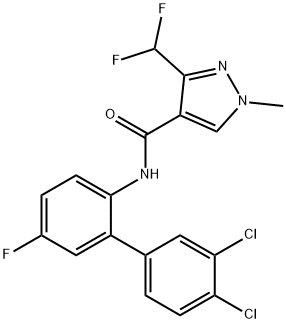
Description
Bixafen is a cereal fungicide used in the control of stem and leaf diseases. It has a low aqueous solubility and is not volatile. This substance can be very environmentally persistent but is not expected, based on its physico-chemical properties, to leach to groundwater. It is highly toxic to fish, moderately toxic to birds, aquatic invertebrates and algae but has a low toxicity to honeybees. Bixafen has a low mammalian toxicity via the oral route and is a probable reproduction/developmental toxin.
Chemical Properties
Bifenpyrad is white powder, melting point 142.9°C, vapor pressure 4.6×10³mPa(20°C), K . lgP =3.3(20℃), relative density 1.51(20℃), solubility in water 0.49mg/L(pH 7,20℃). Stable to light and water (pH 4~9).
Uses
Bixafen is a novel succinate dehydrogenase inhibitor fungicide found in vegetables and fruits.
Definition
ChEBI: An aromatic amide obtained by formal condensation of the carboxy group of 3-(difluoromethyl)-1-methylpyrazole-4-carboxylic acid with the amino group of 3',4'-dichloro-5-fluorobiphenyl-2-amine. A fungicide for use in cereals for key stem and leaf disease co
trol including strobilurin-resistant septoria.
Production Methods
Bixafen is commercially synthesised by coupling a substituted pyrazole carboxylic acid with a halogenated biphenyl amine. The industrial production of bixafen begins with the preparation of 3-(difluoromethyl)-1-methyl-1H-pyrazole-4-carboxylic acid, which serves as the core scaffold. This intermediate is then reacted with 3',4'-dichloro-5-fluoro-2-aminobiphenyl through an amide bond formation, yielding the active compound.
Mechanism of action
Succinate DeHydrogenase Inhibitor.