Chemical Properties
White powder; odorless; slightly acrid
and faintly sweet taste. Soluble in water;
slightly soluble in dilute alcohol; insoluble in strong
alcohol.
Uses
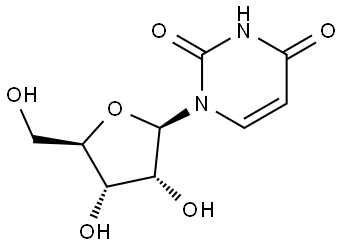
Uridine is a nucleoside, contains a uracil attached to a ribose ring via a β-N1-glycosidic bond
Uses
Uridine is a nucleoside; widely distributed in nature. Uridine is one of the four basic components of ribonucleic acid (RNA)
Definition
ChEBI: Uridine is a ribonucleoside composed of a molecule of uracil attached to a ribofuranose moiety via a beta-N(1)-glycosidic bond. It has a role as a human metabolite, a fundamental metabolite and a drug metabolite. It is functionally related to a uracil.
General Description
Uridine(58-96-8) is a pyrimidine nucleoside which is crucial for the synthesis of RNA and membranes. It helps in normal cell function and growth by forming pyrimidine nucleotide -lipid conjugates. Uridine has been studied as a rescue agent to reduce the toxicities associated with 5-fluorouracil (5-FU), thereby allowing the administration of higher doses of 5-FU in chemotherapy regimens. (NCI04)
Biochem/physiol Actions
Uridine monophosphate is essential for protein glycosylation, polysaccharide biosynthesis and lipid metabolism. Oral administration of uridine is suggested for anisopoikilocytosis and epileptic encephalopathy disorders. Uridine has numerous biological functions like treating dry eye syndrome, regulating nervous system and favors reproduction. High levels of uridine are implicated in insulin resistance.
Synthesis
Cytosine nucleoside (or uracil nucleoside) and adenine nucleoside are used as main raw materials, and uridine is obtained through the transformation of biological cell homogenate, and then microfiltration, precipitation, chromatography and crystallization
target
ATPase | Potassium Channel | p53
Purification Methods
Crystallise �-uridine from aqueous 75% MeOH or EtOH (m 165-166o). [Beilstein 24 III/IV 1202.]