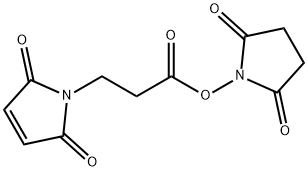
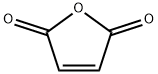
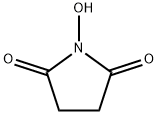
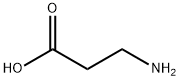
Example 1: Synthesis of NHS esters of N-maleimidopropionic acid
1. Maleic anhydride, β-alanine (1 mole equivalent) and acetonitrile (ACN, 25 v/v) were added to a reaction vessel under nitrogen protection to form a slurry.
2. The slurry was heated to 70 °C and kept stirring for 5-8 hours.
3. After completion of the reaction, cooled to 5 °C, N-hydroxybutanediimide (NHS, 1 mole equivalent) and N-(3-dimethylaminopropyl)-N'-ethylcarbodiimide hydrochloride (EDCI, 1 mole equivalent) were added sequentially.
4. After maintaining the temperature at 0-5 °C for 1 hour of reaction, EDCI (1 molar equivalent) was added again.
5. The reaction mixture was heated to 70 °C and kept stirring for 7 hours.
6. At the end of the reaction, the mixture was cooled to 20 °C and concentrated under vacuum at a temperature not exceeding 45 °C until the rate of solvent distillation was significantly reduced.
7. Dichloromethane (DCM, 40 v/v) was added to the residue and stirred until completely dissolved.
8. The organic phase was washed sequentially with 12% w/w aqueous ammonium chloride (25 wt. eq.) and 24% w/w aqueous sodium chloride (25 wt. eq.).
9. Add magnesium sulfate (1 w/w) to dry the organic solution and stir for 1-2 hours at ambient temperature.
10. Vacuum filtered to remove inorganic salts and the filter cake was washed with DCM (4 v/v).
11. Vacuum concentrate the filtrate while gradually replacing the DCM with isopropyl acetate (IPAC).
12. The resulting slurry was cooled to ambient temperature, stirred for 1 hour and vacuum filtered.
13. The product filter cake was washed with IPAC (4 v/v) and subsequently rotary dried under vacuum at 40 °C to constant weight to give an off-white solid product.
14. Typical yields were 60-80% of the theoretical maximum yield.
Product characterization: 1H NMR (400 MHz, d6-DMSO): δ 2.80 (4H, br s), δ 3.05 (2H, t, J~7 Hz), δ 3.75 (2H, t, J~7 Hz), δ 7.05 (2H, s).