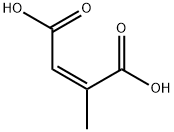
Citraconic acid can be obtained by reacting citraconic anhydride with distilled water, yielding a 94% yield. The specific reaction steps are as follows:
(1) Take a clean 100-millilitre beaker and add 22.4 g (0.2 mol) of citraconic anhydride. Then, add 4 ml (0.22 moles) of distilled water dropwise to the beaker.
(2) Place the mixture on a hotplate and stir until a homogeneous solution is formed.
(3) Cover the beaker with a bell-shaped glass lid, then leave it to stand at room temperature for 48 hours. The mixture will solidify completely. This yields 26 g of crude solid.
(4) Purification: Grind the solid obtained in (3) to a very fine powder in a mortar, wash with 50 ml of cold benzene, allow to air-dry, and then vacuum-dry for 24 hours in a vacuum desiccator containing phosphorus pentoxide. This yields 24.4 g of citraconic acid, with a melting point of 92–93 °C.