Description
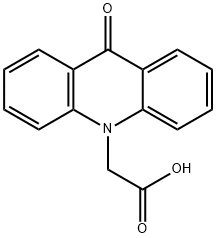
9-Oxo-10(9H)-acridineacetic acid , also known as Cridanimod or XBIO-101, is a small molecule that can increase progesterone receptor (PR) expression, with potential antineoplastic adjuvant activity. Cridanimod is able to induce the expression of PR in endometrial cancer. This could increase the sensitivity of endometrial cancer cells to progestin monotherapy. In combination with a progestin, cancer cells could be eradicated through increased PR-mediated signaling, leading to an inhibition of luteinizing hormone (LH) release from the pituitary gland, via a negative feedback mechanism, and, eventually, an inhibition of estrogen release from the ovaries. This leads to an inhibition of cellular growth in estrogen-dependent tumor cells.
Uses
9-Oxo-10(9H)-acridineacetic acid is a reagent for pre-column derivatization of amino acids for fluorescent determination in HPLC and it is also a building block in pharmaceutics.
Definition
ChEBI:Cridanimod is a member of acridines. It is functionally related to an acridone.
Synthesis
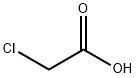
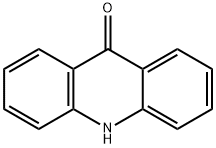
The synthetic method consisted of the following steps: 29.2 g of [Pmim]OH ionic liquid was added to a three-necked flask equipped with a condensation reflux device, followed by the addition of 19.5 g of acridinone and 11.3 g of chloroacetic acid, which was homogenized by stirring at room temperature. The reaction mixture was allowed to stand at room temperature and then reacted under stirring conditions for 12 hours. After completion of the reaction, the residue was washed with 25 mL of methanol and dried to give 24.2 g of 2-(9-oxoacridin-10(9H)-yl)acetic acid in 95.7% yield.
References
[1] Patent: CN104592115, 2017, B. Location in patent: Paragraph 0016; 0017; 0018
[2] Patent: CN108456166, 2018, A. Location in patent: Paragraph 0030; 0044; 0045; 0047; 0050; 0051; 0072
[3] Acta Poloniae Pharmaceutica - Drug Research, 2010, vol. 67, # 2, p. 211 - 214