Synthesis
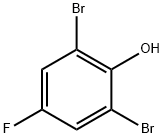
Currently, the main method for synthesizing 2,6-dibromo-4-fluorophenol is to use 4-fluorophenol as a raw material and obtain the target compound through a bromination reaction [1]. Alternatively, the target compound 2,6-dibromo-4-fluorophenol can be obtained by a two-step reaction of boronization and oxidation, starting from 3,5-dibromo-1-fluorobenzene. The synthesis reaction formula is shown in the figure below:
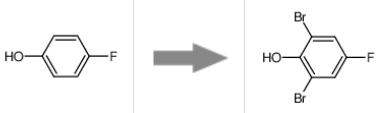
Figure 1 Synthesis reaction formula of 2,6-dibromo-4-fluorophenol
Preparation of 2,6-dibromo-1-fluorophenylboronic acid: 2,2,6,6-tetramethylpiperidine (10.0 g, 70.8 mmol) and 160 mL of dry tetrahydrofuran were added to a 250 mL three-necked flask. Under N2 protection, the temperature was lowered to -78 °C in a low-temperature reactor, and n-butyllithium (21.2 mL, 53.0 mmol) was slowly added dropwise. After the addition was complete, the mixture was stirred for 30 min, and then 3,5-dibromo-1-fluorobenzene (8.3 g, 10.0 mmol) was slowly added dropwise. After the initial addition of 10.0 g (35.2 mmol), the mixture was stirred for 1 h, followed by slow addition of triisopropyl borate (10.0 g, 53.0 mmol). After the addition was complete, the mixture was stirred for another 2 h until the reaction was complete. The reaction solution was slowly poured into ice water and extracted with ethyl acetate (50 mL × 3). The pH of the aqueous phase was adjusted to 3–4 with 1 mol·L⁻¹ hydrochloric acid, and the precipitated solid was filtered, dried, soaked in 10 mL of n-hexane, stirred, filtered, and dried to obtain 5.8 g of 2,6-dibromo-1-fluorophenylboronic acid.
Preparation of 2,6-dibromo-4-fluorophenol: 40 g of water and potassium hydroxide (1.2 g, 21.4 mmol) were added to a 250 mL single-necked flask and completely dissolved. Then, 2,6-dibromo-1-fluorophenylboronic acid (3 g, 10.7 mmol) was added, followed by slow dropwise addition of a 30% aqueous solution of hydrogen peroxide (6.07 g, 53.5 mmol). After the addition was complete, stirring was continued for 10 min. Once the reaction was complete, the pH was adjusted to 5–6 with 1 mol·L⁻¹ hydrochloric acid. The mixture was extracted with ethyl acetate (80 mL × 2). The organic phases were combined, dried over anhydrous sodium sulfate, and evaporated to dryness to obtain a pale yellow crude solid. This crude solid was soaked in 5 mL of n-hexane, stirred, filtered, and dried to obtain 2.6 g of 2,6-dibromo-4-fluorophenol.
;