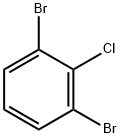
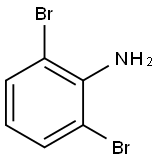
Step 1: Synthesis of 1,3-dibromo-2-chlorobenzene
To a solution of acetonitrile (10 mL) containing isoamyl nitrite (585 mg, 5 mmol) and cuprous chloride (CuCl, 396 mg, 4 mmol) was slowly added 2,6-dibromoaniline (502 mg). The reaction mixture was stirred at 65 °C for 2 hours. Subsequently, an aqueous solution of ammonium tetrafluoroborate (NH4BF4, 4.2 g, 40 mmol) was added dropwise. The reaction mixture was continued to be stirred at 0-10 °C for 1 h and then cooled to room temperature. The reaction solution was concentrated under reduced pressure, dissolved in ethyl acetate (EA, 30 mL) and washed with deionized water (20 mL). The organic layer was dried with anhydrous sodium sulfate (Na2SO4), filtered and concentrated under reduced pressure. The residue was purified by column chromatography using petroleum ether (PE) as eluent to afford 1,3-dibromo-2-chlorobenzene (270 mg, 49% yield) as a white solid.