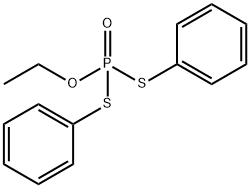
Description
Edifenphos is an organochlorine rice fungicide. It is moderately soluble in water and is volatile. Based on its chemical properties it is not expected to leach to groundwater. It is not usually persistent in either soil or water systems. Edifenphos is moderately toxic to mammals it is also a neurotoxin and an acetyl cholinesterase inhibitor. It is moderately toxic to fish and poses more of a risk to aquatic invertebrates.
Chemical Properties
The industrial product is a yellow to light brown, transparent liquid with a foul odor. Its bp is 154°C/1.33 Pa, relative density is 1.23 (20°C), and refractive index n22D is 1.61. It is soluble in organic solvents such as methanol, ether, chloroform, acetone, benzene, and xylene, but poorly soluble in water. Its half-life at 25°C is 1.135 hours (pH = 7) and 49 hours (pH = 9). It is relatively stable under acidic conditions but prone to hydrolysis or transesterification under alkaline conditions, especially at high temperatures.
Uses
Edifenphos is a foliar applied contact fungicide that provides both
protective and curative control of rice blast diseases caused by Pyricularia
oryzae. It also controls ear blight and stem rot in rice.
Definition
ChEBI: An organic thiophosphate that is the O-ethyl-S,S-diphenyl ester of phosphorodithioic acid. Used to control a variety of fungal diseases on rice including blast, ear blight and stem rot. Edifenphos i
moderately toxic to mammals and fish but poses more of a risk to aquatic invertebrates.
Production Methods
Edifenphos is commercially synthesised through the esterification of diphenyl dithiophosphoric acid with ethanol. This process involves reacting phosphorus pentasulfide with phenol to produce diphenyl dithiophosphoric acid, which is then treated with ethanol to form edifenphos.
Mechanism of action
Phospholipid biosynthesis inhibition, foliar applied with protective and curative action
Metabolic pathway
Hydrolytic cleavage of the P-0 and P-S linkages affords the major
degradation and metabolic pathways of edifenphos. A unique transesterification
reaction yielded tri-S-phenyl and di-O-ethyl phosphorus
esters as minor products in soil and plant test systems (Scheme 1).
Degradation
The hydrolytic DT50 values of edifenphos (1) at pH 7 and 9 at 25 °C
were 19 and 2 days, respectively (PM). [35S]Edifenphods egraded rapidly
in aqueous solution when exposed to UV light at 25-28 °C [DT50 ca. 3 days
(light exposed) vs. 19 days (dark control)]. Cleavage of the P-S linkage is
the primary degradation pathway. Thiophenol (2) was further oxidised
to form diphenyl disulfide (3), possibly during sample extraction, isolation
and analysis. Stepwise cleavage of the P-S and P-O linkages yielded
O-ethyl S-phenyl hydrogen phosphorothioate (4), S-phenyl dihydrogen
phosphorothioate (5), benezenesulfonic acid (6) and sulfuric acid as
major 35S-containing products, whereas O-ethyl dihydrogen phosphate
(7) and phosphoric acid were recovered from the phosphorus portion of
the molecule (Murai, 1977).
Toxicity evaluation
Edifenphos shows no delayed neuropathic symptoms.
Safety intervals between spray and harvest for rice are
21 days in Japan with 0.2 mg of MRL (Maximum Residue
Limit).