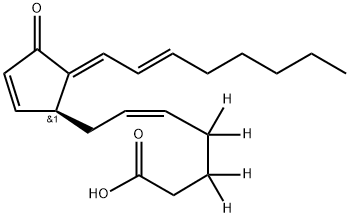
Description
15-deoxy-Δ12,14-PGJ2-d4 contains four deuterium atoms at the 3, 3'', 4, and 4'' positions. It is intended for use as an internal standard for the quantification of 15-deoxy-Δ12,14-PGJ2 by GC- or LC-mass spectrometry. 15-deoxy-Δ12,14-Prostaglandin J2 (15-deoxy-Δ12,14-PGJ2) is a metabolite of PGJ2. 15-deoxy-Δ12,14-PGJ2 is formed from PGD2 by the elimination of two molecules of water. It binds selectively to PPARγ with an EC50 of 2 μM in a murine chimera system. 15-deoxy-Δ12,14-PGJ2 is more potent than PGD2, Δ12-PGJ2, and PGJ2 in stimulating lipogenesis in C3H10T1/2 cells. The EC50 for induction of adipocyte differentiation in cultured fibroblasts is 7 μM.
Uses
15-Deoxy-Δ-12,14-prostaglandin J2-d4 is the deuterium labeled 15-Deoxy-Δ-12,14-prostaglandin J2. 15-Deoxy-Δ-12,14-prostaglandin J2 (15d-PGJ2) is a cyclopentenone prostaglandin and a metabolite of PGD2. 15-Deoxy-Δ-12,14-prostaglandin J2 is a selective PPARγ (EC50 of 2 μM) and a covalent PPARδ agonist. 15-Deoxy-Δ-12,14-prostaglandin J2 promotes efficient differentiation of C3H10T1/2 fibroblasts to adipocytes with an EC50 of 7 μM[1][2].
References
[1] Russak EM, et al. Impact of Deuterium Substitution on the Pharmacokinetics of Pharmaceuticals. Ann Pharmacother. 2019;53(2):211-216. DOI:
10.1177/1060028018797110[2] Reddy AT, et al. Identification and Molecular Characterization of Peroxisome Proliferator-Activated Receptor δ as a Novel Target for Covalent Modification by 15-Deoxy-Δ12,14-prostaglandin J2. CS Chem Biol. 2018 Dec 21;13(12):3269-3278. DOI:
10.1021/acschembio.8b00584[3] Kliewer SA1, et al. A prostaglandin J2 metabolite binds peroxisome proliferator-activated receptor gamma and promotes adipocyte differentiation. Cell. 1995 Dec 1;83(5):813-9. DOI:
10.1016/0092-8674(95)90194-9