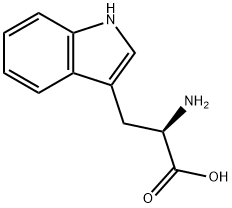
General Description
White solid.
Reactivity Profile
Amines are chemical bases. They neutralize acids to form salts plus water. These acid-base reactions are exothermic. The amount of heat that is evolved per mole of amine in a neutralization is largely independent of the strength of the amine as a base. Amines may be incompatible with isocyanates, halogenated organics, peroxides, phenols (acidic), epoxides, anhydrides, and acid halides. Flammable gaseous hydrogen is generated by amines in combination with strong reducing agents, such as hydrides.
Air & Water Reactions
Slightly soluble in water.
Fire Hazard
Flash point data are not available for this chemical, but D(+)-TRYPTOPHAN is probably combustible.
Chemical Properties
white powder
Uses
An essential amino acid found in naturally produced pedtides. Unlike its stereoisomer, L-tryptophan, it is not used in structural or enzyme proteins.
Uses
An essential amino acid found in naturally produced peptides. Unlike its stereoisomer, L-tryptophan, it is not used in structural or enzyme proteins.
Definition
ChEBI: The D-enantiomer of tryptophan.
Antimicrobial activity
Research showed that when D-tryptophan was used with other stresses such as using different salt concentrations, refrigeration, or high temperatures, it showed significant antimicrobial effects on Gram-positive and Gram-negative food-borne pathogens, and antibiofilm impacts were also observed with D-tryptophan[2].
Pharmaceutical Applications
Preclinical and emerging clinical findings suggest that D-tryptophan may influence neural plasticity and cognitive processes through modulation of NMDA receptor activity, glutamatergic neurotransmission, and neurotrophic factor release. Beyond cognitive domains, potential benefits may extend to behavioral and mood regulation, highlighting their multifaceted role in Central Nervous System (CNS) health[1].
Biochem/physiol Actions
Low level of D-tryptophan is capable of preventing the growth of an?L-tryptophan-requiring mutant of the?E. coli.