Synthesis
The synthetic route of (R)-alpha,alpha-Diphenylmethylprolinol is shown in the figure below: 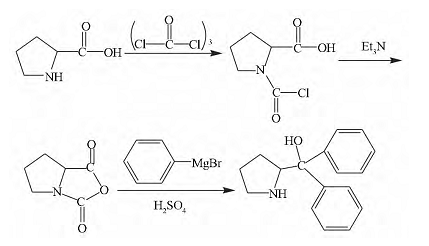
20g proline (0.174mol), 18g triphosgene (0.061mol), and 250mL anhydrous tetrahydrofuran were added to a reaction flask and stirred at room temperature. After 2-3 hours, the reaction system became clear. The reaction was monitored by TLC (ninhydrin color development) to ensure that the proline reaction was complete.
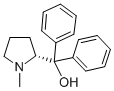
The reaction solution was cooled to 0°C, and a suitable amount of triethylamine was added dropwise, maintaining the temperature between 0 and 5°C. The reaction was monitored by TLC. After the reaction was complete, triethylammonium chloride was removed by filtration, yielding a proline-N-carboxylic acid anhydride solution. The proline-N-carboxylic acid anhydride solution was then added dropwise to a suitable amount of magnesium bromide Grignard reagent tetrahydrofuran solution at low temperature, maintaining the temperature between -5 and 5°C. After the addition was complete, the mixture was stirred at room temperature. After the reaction was complete, the Grignard reagent was quenched with 1M concentrated sulfuric acid. The resulting magnesium sulfate was filtered off, and the filtrate was concentrated by half to precipitate diphenylproline sulfate. The product was dissolved in a 1:1 mixture of 1 mol/L NaOH solution and tetrahydrofuran, and then washed three times with toluene. The toluene layer was collected, dried, and the solvent was evaporated to obtain a white solid product of diphenylproline. At room temperature, diphenylproline, zinc powder, and sodium dihydrogen phosphate were added to a round-bottom flask, along with water and formaldehyde aqueous solution. The mixture was reacted at room temperature for 20 hours. After the reaction was complete, the mixture was filtered, and methanol was added. The filtrate was then rotary evaporated to obtain a white solid (R)-alpha,alpha-Diphenylmethylprolinol.;

 ;
;