Chemical Properties
white or light yellow powder
Definition
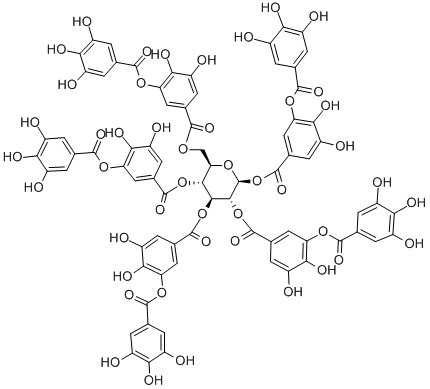
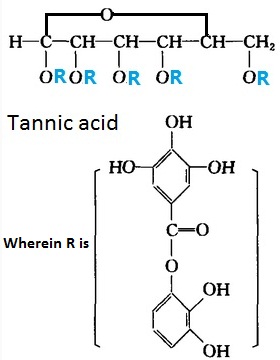
ChEBI: A gallotannin obtained by acylation of the five hydroxy groups of D-glucose by 3,4-dihydroxy-5-[(3,4,5-trihydroxybenzoyl)oxy]benzoic acid (a gallic acid dimer).
General Description
Light yellow to tan solid with a faint odor. Sinks and mixes with water.
Air & Water Reactions
Water soluble. Gradually darkens on exposure to air and/or light
Reactivity Profile
Glycerite decomposes at 210° to carbon dioxide and pyrogallol, which can form irritating vapors [USCG, 1999]. Incompatible with salts of heavy metals, alkaloids, gelatin, albumin, starch, oxidizing substances-e.g., permanganates, chlorates; lime water [Merck].
Health Hazard
Inhalation causes irritation of nose and throat, coughing, and sneezing. Ingestion may cause gastric disturbance. Contact with eyes causes irritation.
Fire Hazard
Special Hazards of Combustion Products: Decomposes at 210° to carbon dioxide and pyrogallol, which can form irritating vapors.
Description
Tannic acid is a naturally occurring plant polyphenol and can
be found in practically all aerial plant tissues. Tannic acid was
historically used for the treatment of diarrhea, topically to dress
skin burns and rectally for treatment of unspecified rectal
disorders. Pharmaceutical use of tannic acid is discontinued
due to safer and better alternatives.
An unusually high incidence of esophageal cancer has been
noted in areas of South Africa, where a sorghum rich in tannins
is consumed. A positive relation has been observed between the
tannin content of the sorghum and the incidence of esophageal
cancer.
Occurrence
Reported found in Quercus oliver and related species; Tara (Caesalpinia spinosa); and various sumac species, including Rhus semialata, R. coriaria, R. glabra and R. typhia.
Preparation
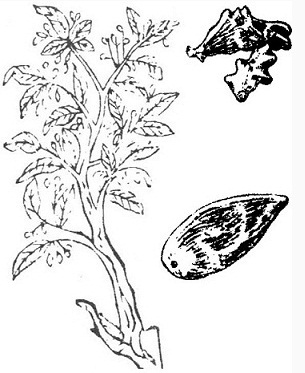
Tannic acid is obtained by solvent extraction from the nutgalls or the excrescences that form on the young twigs of Quercus olivier and allied species of Quercus L.; from the seed pods of Tara (Caesalpinia spinosa); or from the nutgalls of various sumac species, including Rhus semialata, R. coriaria, R. glabra and R. typhia.
Composition
Main constituents include three crystalline alkaloids—aspidospermine, quebrachine and quebrachamine (chemically identical to yohimbine)—responsible for the tonic and antispasmodic physiological action. A. quebrachoblanco bark contains 0.3 to 1.5% alkaloids (aspidospermine 30%, quebrachine 10%, deacetylaspidospermine 5%, aspidospermatidine 3%, 1-methylaspidospermatidine 0.5%, quebrachimine and quebrachit). Leaves contain rhazinilam (lactam).
Hazard
Toxic by ingestion and inhalation. Questionable
carcinogen.
Industrial uses
Quebracho is the most common tannic acid derivative widely used in flotation. The
main phenolic nuclei present in Quebracho are resorcinol/phloroglucinol and catechol/pyrogallol.
Quebracho is commercially available in the following three forms: (a) standard
Quebracho, a direct hot-water extract from the heart-wood with adjusted pH (Qu–O), (b)
sulfited Quebracho, in which sulfonic acid groups have been introduced (Qu–S) and (c)
aminated Quebracho (Qu–A), where amine groups are introduced to ordinary Quebracho,
rendering the polymer amphoteric (iso-electric point at pH 7). Each of these types of
Quebracho has a different depressing effect.
Materials Uses
Tannic acid has been demonstrated to be capable of making a great contribution to the membrane science and technology. Especially in membrane surface/interface engineering (such as the construction of superhydrophilic and antifouling surfaces and polymer/nanoparticle interfaces with high compatibility) and development of thin film composite membranes with high permselectivity (such as developing thin film composite membranes with ultrahigh flux and high rejection), tannic acid can play a positive and great role[1].
Anticancer Research
Tannins, an astringent organic compound, are toxic to many microorganisms due toinhibition of oxidative phosphorylation (Scalbert 1991). It is responsible for thepuckering feeling in the human mouth following the consumption of unripe fruits ortea (Vidal et al. 2004). Pomegranates (Punica granatum) have been widely studiedfor their potent antioxidants, which include ellegitannin, elegiac acid, and punicalagin,which are commonly known for their anti-proliferative and apoptotic effects oncolon cancer cell lines (Seeram et al. 2005). Herbs such as cloves (Syzygium aromaticum)can also play important role in preventing and treating some cancers.Cervical, breast, prostate, and oesophageal cancer cells were killed within 24 h afterthe application of clove oil (Dwivedi et al. 2011). It was also found effective in treatinglung cancer by means of in situ cell proliferation (Banerjee et al. 2006). Tarragon(Artemisia dracunculus) extract is indicated as cytotoxic to breast cancer thoughregulation of certain proteins that induce apoptosis (Obolskiy et al. 2011). Tarragonalso contains potent compounds such as sakuranetin and 6-methoxycapilliarisin thatappear to have anticancer effects on oesophageal cancer by inducing DNA damagein the cancerous cells (Hong and Ying 2015). Cumin (Cuminum cyminum) has beenused since ancient times, and some studies have shown it to have a cytotoxic effectto colorectal cancer cell lines (Prakash and Gupta 2014; Al-Snafi 2016). Thyme(Thymus vulgaris) essential oil has been claimed to demonstrate cytotoxic activity on head and neck squamous cell carcinomas by interrupting reproduction at the transcriptionallevel of cancer cells, with effects such as interfering in N-glycan biosynthesisand extracellular signal-regulated kinase 5 signalling (Sertel et al. 2011).Cinnamon (Cinnamomum sp.) is most commonly known as culinary spice, yet it isalso used for its medicinal properties in treating gastrointestinal sickness. Cinnamonbark extract was evaluated for anticancer ability, and it was found to induce apoptosisin HepG2 cells (liver cancer cells) after 24 h at certain dosages (Varalakshmiet al. 2014). An extract of cinnamon, 2′-hydroxycinnamaldehyde, shows severalantitumour effects on oral cancer cell lines; this is demonstrated by anti-proliferativeactivity of apoptotic cells and inhibition of tumour mass growth (Kim et al. 2010).
Synthesis
Tannic acid is synthesized by extraction from Nutgalls (Chinese or Turkish), Myrobalans (Terminalia SP.), Oakbark, etc. It is also synthesized by esterification of Glucose with meta-galloylgallic acid.
Environmental Fate
Tannins and tannic acid occur naturally in plants. Essentially all
wood and plant tissue contain tannins. Therefore, biodegradation
is expected to be the major environmental fate process
for tannic acid.
storage
Store at -20°C, protect from light
Toxicity evaluation
Tannic acid causes centrilobular liver necrosis following
absorption from gastrointestinal tract, mucus membranes, or
denuded skin surfaces. Liver metabolism of tannic acid requires
methyl-group donors. Therefore, methyl-group donors can be
depleted following excessive tannic acid absorption.
References
[1] Yan, W., Shi, M., Dong, C., Liu, L., Gao, C. (2020). Applications of tannic acid in membrane technologies: A review. Advances in Colloid and Interface Science, 284, Article 102267.
https://doi.org/10.1016/j.cis.2020.102267