
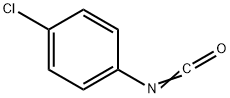
104-12-1
| Name | 4-Chlorophenyl isocyanate |
| CAS | 104-12-1 |
| EINECS(EC#) | 203-176-9 |
| Molecular Formula | C7H4ClNO |
| MDL Number | MFCD00002024 |
| Molecular Weight | 153.57 |
| MOL File | 104-12-1.mol |
Chemical Properties
| Appearance | white to yellow crystalline solid |
| Melting point | 26-29 °C (lit.) |
| Boiling point | 203-204 °C (lit.) |
| density | 1.2 g/mL at 25 °C(lit.) |
| vapor pressure | 30Pa at 20℃ |
| refractive index | n |
| Fp | >230 °F |
| storage temp. | 2-8°C |
| solubility | Chloroform (Slightly) |
| form | Crystalline Solid |
| color | White to yellow |
| Odor | sharp irritating odor |
| Water Solubility | DECOMPOSES |
| Sensitive | Moisture Sensitive/Lachrymatory |
| BRN | 386235 |
| Henry's Law Constant | 5.7×10⁻² mol/(m3Pa) at 25℃, Zhang et al. (2010) |
| InChI | 1S/C7H4ClNO/c8-6-1-3-7(4-2-6)9-5-10/h1-4H |
| InChIKey | ADAKRBAJFHTIEW-UHFFFAOYSA-N |
| SMILES | Clc1ccc(cc1)N=C=O |
Safety Data
| Symbol(GHS) |     GHS05,GHS06,GHS08,GHS09 |
| Signal word | Danger |
| Hazard statements | H301-H315-H318-H330-H334-H335-H410 |
| Precautionary statements | P260-P273-P280-P302+P352-P304+P340+P310-P305+P351+P338 |
| Hazard Codes | T+,T,C |
| Risk Statements | |
| Safety Statements | |
| RIDADR | UN 2811 6.1/PG 2 |
| WGK Germany | 3 |
| RTECS | NQ8575000 |
| F | 10-19-21 |
| Hazard Note | Toxic/Corrosive/Lachrymatory/Moisture Sensitive |
| TSCA | Yes |
| REACH Registrations | Active |
| HazardClass | 6.1 |
| PackingGroup | II |
| HS Code | 29291090 |
| Storage Class | 6.1A - Combustible acute toxic Cat. 1 and 2 very toxic hazardous materials |
| Hazard Classifications | Acute Tox. 2 Inhalation Acute Tox. 3 Oral Aquatic Acute 1 Aquatic Chronic 1 Eye Dam. 1 Resp. Sens. 1 Skin Irrit. 2 STOT SE 3 |
| Safety Profile | |
| Hazardous Substances Data | 104-12-1(Hazardous Substances Data) |
| Toxicity |