[1] ROMANA FATO . Differential effects of mitochondrial Complex I inhibitors on production of reactive oxygen species[J]. Biochimica et Biophysica Acta-Bioenergetics, 2009, 1787 5: Pages 384-392. DOI:
10.1016/j.bbabio.2008.11.003[2] XUEFENG ZHOU William F. The unique chemistry and biology of the piericidins[J]. Journal of Antibiotics, 2016, 69 8: 582-593. DOI:
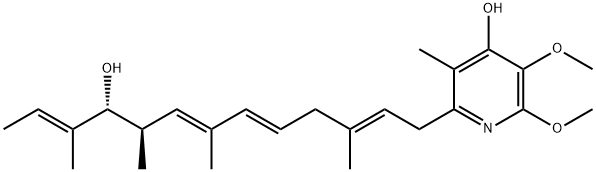
10.1038/ja.2016.71[3] ROBERT D. BONGARD Marilyn P M Mary I Townsley. The effects of mitochondrial complex I blockade on ATP and permeability in rat pulmonary microvascular endothelial cells in culture (PMVEC) are overcome by coenzyme Q1 (CoQ1)[J]. Free Radical Biology and Medicine, 2015, 79: Pages 69-77. DOI:
10.1016/j.freeradbiomed.2014.09.030[4] KANG KWANG LEE . Isoniazid-induced cell death is precipitated by underlying mitochondrial complex I dysfunction in mouse hepatocytes[J]. Free Radical Biology and Medicine, 2013, 65: Pages 584-594. DOI:
10.1016/j.freeradbiomed.2013.07.038[5] WON-SEOK CHOI Zhengui X Richard D Palmiter. Loss of mitochondrial complex I activity potentiates dopamine neuron death induced by microtubule dysfunction in a Parkinson’s disease model.[J]. Journal of Cell Biology, 2011, 192 5: 873-882. DOI:
10.1083/jcb.201009132[6] JI-HWAN HWANG. Etoposide-resistant HT-29 human colon carcinoma cells during glucose deprivation are sensitive to piericidin A, a GRP78 down-regulator[J]. Journal of Cellular Physiology, 2007, 215 1: 243-250. DOI:
10.1002/jcp.21308