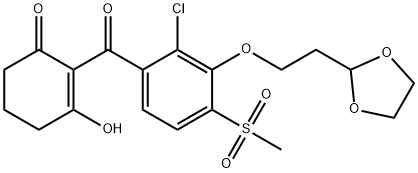
Lancotrione is produced through a streamlined, multi-fragment assembly typical of modern HPPD-inhibiting herbicides. Commercial manufacture begins with construction of the triketone-type core, usually formed by condensing a beta-dicarbonyl precursor with an appropriately substituted aromatic aldehyde under conditions that tightly control enolisation and ring formation. In parallel, the fluorinated and chlorinated aromatic fragment that defines lancotrione’s selectivity is prepared using established halogen-management chemistry designed to preserve the stability of the heteroaromatic ring. These advanced intermediates are then joined through a selective carbon-carbon or carbon-heteroatom bond forming step that assembles the full lancotrione scaffold without degrading the sensitive halogenated groups.