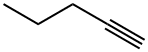
It can be synthesized from haloalkanes and sodium acetate. The specific steps are as follows: dissolve sodium acetate in ethanol to prepare a solution; add haloalkanes, such as bromopentane, to the solution; stir the mixture at an appropriate temperature; and purify the mixture by distillation to obtain compound 1-pentyne.
Clear colorless to pale yellow liquid
1-Pentyne has been used in preparation of:
- lithium acetylides, required for asymmetric synthesis of α,α-dibranched propargyl sulfinamides
- 7-hydroxy-10-methoxy-3H-naphtho[2.1-b]pyrans
1-Pentyne has been used in preparation of:lithium acetylides, required for asymmetric synthesis of α,α-dibranched propargyl sulfinamides. It is also used to synthesize 7-hydroxy-10-methoxy-3H-naphtho[2.1-b]pyrans.
Selective and non-selective hydrogenation of 1-pentyne catalyzed by silica-supported palladium has been studied by in situ X-ray absorption spectroscopy.
Dangerous fire hazard when exposed to heat or flame; can react vigorously with oxidizing materials. When heated to decomposition it emits acrid smoke and irritating fumes. See also ACETYLENE COMPOUNDS