Mithramycin is an antineoplastic antibiotic produced by
Streptomyces plicatus. It is well known as the aureolic acid
antitumor antibiotic that inhibits both cancer growth and
bone resorption by cross-linking GC-rich DNA, thus
blocking binding of Sp-family transcription factors to
gene regulatory elements. Transcription of c-Src, a gene
implicated in many human cancers and required for
osteoclast-dependent bone resorption, is regulated by the
binding of Sp factors to specific elements in its promoter.
Therefore, this gene represents an important anticancer
target and a potential lead target through which mithramycin
displays action against osteoclastic bone resorption
via an unknown mechanism. Hazards of handling this
drug by the health-care personnel arise from a combination
of factors: (1) its inherent toxicity and (2) the extent
to which workers are exposed to the drug in the course of
carrying out their duties. This exposure may be through
inadvertent ingestion of the drug on foodstuffs (e.g.,
workers’ lunches), inhalation of drug dusts or droplets, or
direct skin contact. Mithramycin has been used to
decrease bone resorption in patients with humoral
hypercalcemia and Paget’s disease.
Mithramycin was the first of the aureolic acid class of antitumour antibiotics, isolated from Streptomyces. Mithramycin inhibits transcription and protein synthesis by non-covalent binding with G-C-rich duplex DNA in the presence of magnesium and zinc ions. Mithramycin also induces differentiation of leukemic cells accompanied by an early decrease in c-myc expression, and selectively inhibits collagen-1 gene expression in human fibroblasts.
Mithramycin A was the first of the aureolic acid class of antitumor antibiotics, isolated from Streptomyces. Mithramycin inhibits transcription and protein synthesis by non-covalent binding with G-C-rich duplex DNA in the presence of magnesium and zinc ions. Mithramycin also induces differentiation of leukemic cells accompanied by an early decrease in c-myc expression, and selectively inhibits collagen-1 gene expression in human fibroblasts.
Plicamycin (mithramycin, Mithracin) is one of the chromomycin
group of antibiotics produced by Streptomyces
tanashiensis. Plicamycin binds to DNA and inhibits transcription.
It also inhibits resorption of bone by osteoblasts,
thus lowering serum calcium levels.Very little is
known about its distribution, metabolism, and excretion.
Because of its severe toxicity, plicamycin has limited clinical
utility.The major indication for plicamycin therapy is
in the treatment of life-threatening hypercalcemia associated
with malignancy. Plicamycin also can be used in
the palliative therapy of metastatic testicular carcinoma
when all other known active drugs have failed.
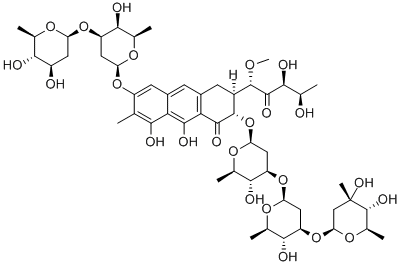
ChEBI: Mithramycin is a carbohydrate-containing antibiotic, an anthracycline antibiotic, an aureolic acid and a secondary alpha-hydroxy ketone. It has a role as an antineoplastic agent, an EC 2.7.7.6 (RNA polymerase) inhibitor and a metabolite.
Mithramycin, recently renamed plicamycin, was found in the culture broth of Streptomyces argillaceus and S. tanashiensis by Abbott Laboratories in 1952. It is structurally related to chromomycin A3. Mithramycin shows strong inhibitory activity against malignant cells of human origin. It acts by inhibition of the DNA-directed RNA synthesis through binding with DNA. Mithramycin is used intravenously to treat cancers of the embryonal cells, seminoma, choriocarcinoma, etc.
Mithracin (Pfizer) [Name
previously used: Mithramycin.].
Chemical structure: aureolic acid
Anticancer antibiotic that selectively binds to G-C-rich DNA in the presence of Mg 2+ or Zn 2+ , inhibiting RNA and DNA polymerase action. Inhibits c-myc expression and induces myeloid differentiation of HL-60 promyelocytic leukemia cells.
Anticancer antibiotic. Inhibits transcription and protein synthesis. Binds to DNA in native chromatin. Substrate of Pgp in MDR phenotypes.
Purify mithramycin A by crystallisation from CHCl3. It is soluble in MeOH, EtOH, Me2CO, EtOAc, Me2SO and H2O, and moderately soluble in CHCl3, but is slightly soluble in *C6H6 and Et2O. It is a fluorescent antitumour agent used in flow cytometry. [Thiem & Meyer Tetrahedron 37 551 1981, NMR: Yu et al. Nature 218 193 1968, Beilstein 17/1 V 672.]
Mithramycin inhibits mRNA and protein synthesis by adhering
to DNA. Mithramycin appears to affect bone resorption by
stimulating osteoclast activity and results in hypocalcemia and
hypophosphatemia. It is believed to lower serum calcium
concentrations, but the exact mechanism is unknown. It may
act by blocking hypercalcemic action of vitamin D or by
inhibiting the effect of parathyroid hormone on osteoclasts. Its
inhibition of DNA-dependent RNA synthesis appears to render
osteoclasts unable to fully respond to parathyroid hormone
with the biosynthesis necessary for osteolysis.
Mithramycin A is an antibiotic that binds the minor groove in GC-rich regions of DNA to inhibit transcription factor-DNA binding and prevent transcriptional activation. Mithramycin A is a specific inhibitor of specificity protein 1, a ubiquitously expressed transcription factor that plays a role in control of cell growth and differentiation, apoptosis, and the immune response. Inhibition of SP1 by Mithramycin A leads to suppression of downstream targets, including proto-oncogenes ha-RAS12 and c-Myc13, anti-apoptotic genes survivin14 and XIAP15, and the pro-angiogenic gene VEGF. Mithramycin A inhibition of SP1 suppresses anti-apoptotic gene expression and induces caspase-dependent apoptosis. Several studies demonstrated that nanomolar concentrations of Mithramycin A could suppress tumor growth with no apparent effect on normal cell division. Mithramycin A was used therapeutically to treat testicular cancer and myeloid leukemia. Additional work suggests a possible role of Mithramycin A in treating cervical and colorectal cancer.
[1] RUO-KAI LIN Yi C W Chun Hua Hsu. Mithramycin A inhibits DNA methyltransferase and metastasis potential of lung cancer cells.[J]. Anti-Cancer Drugs, 2007, 18 10: 1157-1164. DOI:
10.1097/cad.0b013e3282a215e9[2] Combined treatment of pancreatic cancer cells with mithramycin A and tolfenamic acid promotes Sp1 degradation and synergistic anti-tumor activity
[3] TAE-JIN LEE. Mithramycin A sensitizes cancer cells to TRAIL-mediated apoptosis by down-regulation of XIAP gene promoter through Sp1 sites.[J]. Molecular Cancer Therapeutics, 2006, 5 11: 2737-2746. DOI:
10.1158/1535-7163.mct-06-0426