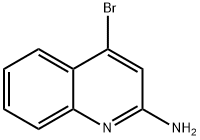
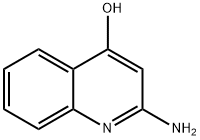
The general procedure for the synthesis of 2-amino-4-bromoquinoline from 2-amino-4-hydroxyquinoline was as follows: 2-aminoquinolin-4-ol (0.7 g, 4.37 mmol) was added to a pressure tube, followed by phosphorus tribromide oxide (2.51 g, 8.74 mmol) and phosphorus tribromide (3 mL, 31.8 mmol). The pressure tube was sealed and the reaction was heated at 150°C for 19 hours under nitrogen protection. Upon completion of the reaction, the reaction mixture was cooled to room temperature, alkalized with 2 M aqueous sodium hydroxide (10 mL) and subsequently extracted with ethyl acetate (3 x 25 mL). The organic layers were combined, washed with water (20 mL), dried over anhydrous sodium sulfate and concentrated under reduced pressure. The resulting solid was washed with hexane (20 mL) to remove non-polar impurities and dried under reduced pressure to give a dark brown residue. This residue was purified by silica gel column chromatography (using a gradient elution of methanol and chloroform) to give 4-bromoquinolin-2-amine (160 mg, 0.71 mmol, 16% yield). LC-MS (ESI) m/z 223.0 (bromine isotope mode) [(M + H)+, calculated value C9H8BrN2, 223.0]; LC-MS retention time (method B): tR = 1.14 min.