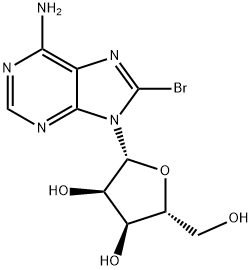
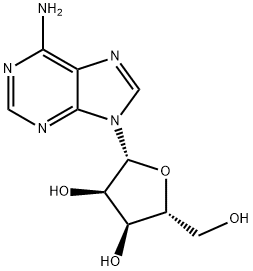
The general procedure for the synthesis of (2R,3R,4S,5R)-2-(6-amino-8-bromo-9H-purin-9-yl)-5-(hydroxymethyl)tetrahydrofuran-3,4-diol from (2R,3R,4S,5R)-2-(6-amino-8-bromo-9H-purin-9-yl)-5-(hydroxymethyl)tetrahydrofuran-3,4-diol is as follows: embodiment 1: the modified The synthesis of siRNA molecules involves the preparation of 8-methoxyadenosine phosphoramidite and its incorporation in the antisense chain of cystatinase 2 siRNA. FIG. 7A illustrates the structure of double-stranded positive control siRNAs (SEQ ID NO:20 (upper strand) and SEQ ID NO:21 (lower strand)) versus double-stranded negative control siRNAs (SEQ ID NO:22 (upper strand) and SEQ ID NO:23 (lower strand)). FIG. 7B illustrates a schematic representation of individually modified siRNAs, wherein the modifications include, but are not limited to, 8-malonylideneoxyadenosine, 8-phenylethoxyadenosine, and 8-cyclohexylethoxyadenosine. In FIG. 7B, 4AS corresponds to SEQ ID NO:24, 6AS corresponds to SEQ ID NO:25, 10AS corresponds to SEQ ID NO:26, and 15AS corresponds to SEQ ID NO:27. Bromination reactions of adenosine have been reported in the field of chemistry; typically, yields of 8-bromoadenosine ranging from about 75% to about 82.5% are obtained using a fourfold excess of bromine. During the synthesis of nucleo-phosphoramidites, the 5'-OH of N'-benzoyl adenosine was first protected in order to protect the 2'-OH group. Subsequently, 2'-OH was protected using tert-butyldimethylsilyl chloride (TBDMS-Cl).Although the addition of Ag+ ions helped to reduce the unwanted reaction of 3'-OH, side reactions usually still occurred, leading to a significant decrease in the overall yield. Therefore, in order to increase the overall yield, a novel protecting group, dibutylmethylsilyl disilicate (DTBSDT), was employed, which protects both 5'-OH and 3'-OH and makes 2'-OH easily protected by TBDMS-Cl. The two reactions are essentially one-pot reactions, avoiding cumbersome separation steps. The reaction was nearly quantitative and the product yield was about 96% to 98% (see Figures 3 and 4). In methanol, the methoxy derivatives were synthesized using sodium methanol reagents to give 8-methoxyadenosine derivatives and 8-oxoadenosine derivatives. The isolation of these two derivatives was more complicated and the yield of the desired compounds was less than 50%. Therefore, by reacting n-BuLi with an excess of anhydrous methanol to generate the methoxy anion in situ, the reaction is much more efficient, with yields of about 85% to 93% of the desired product. Deprotection of 5'-OH and 3'-OH was accomplished at subzero temperature using a special fluoride reagent, HF-pyridine. The product yields of these DMT reactions were low, about 40% to 50%. The product yield of the phosphoramidite synthesis step was about 95% to 98%. Subsequently, 8-methoxyadenosine phosphoramidite is doped into positions 9 or 14 of the antisense chain (corresponding to positions 11 and 6 of the sense chain, respectively), or both positions 9 and 14. The propargyl portion of adenosine at position 8 simplifies the synthesis of other 8-substituted adenosine analogs. The propargyl portion of 8-alkynyl adenosine in the siRNA can be reacted with a suitable water-soluble azide via a "click" reaction to form the desired minor groove modification.